Whatsapp
  X
X  Mail
Mail  Copy link
 A Different Approach to Potassium Efficiency with Acetates

On this page:
Potassium plays a critical role in crop performance, influencing everything from water movement and nutrient uptake to stress tolerance, stalk strength, seed quality, and overall yield potential. But not all potassium fertilizers perform the same in the field.
As growers continue looking for ways to improve nutrient efficiency while reducing salt stress and chloride buildup, chloride-free potassium sources are becoming increasingly important. Potassium acetate offers this different approach. With a focus on maximizing uptake, it provides a more effective, crop-safe approach to potassium nutrition compared to many conventional potassium fertilizers.
Looking Beyond Traditional Potassium Sources
Many growers rely on muriate of potash (MOP), also known as potassium chloride (KCl), because of its affordability and high potassium concentration. However, chloride-based potassium fertilizers can create challenges under certain soil and environmental conditions.
Excess chloride can:
- Increase soil salinity
- Reduce nutrient balance
- Contribute to crop burn
- Interfere with nutrient uptake
- Increase stress in sensitive crops
- Accumulate in soils over time
Chloride-related stress can become even more problematic during drought conditions or in sandy soils where nutrient movement and salinity management are more difficult.
Potassium Acetate – What is Uptake K?
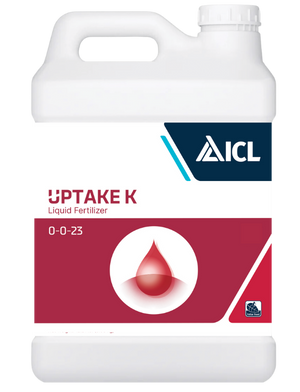
Uptake K is a chloride-free, low-salt potassium fertilizer formulated with potassium acetate and liquid humates.
Potassium acetate: In the chemical context, potassium acetate is a non-chloride salt. It does not cause the same kind of long-term soil salinity issues as a sodium chloride, for example. It is made up of tiny, highly soluble potassium ions (\(K^{+}\)) and acetate ions (CH3COO-) that easily penetrate leaves.
Acetates are known for their superior ultra-fast absorption, high solubility and chloride-free composition.
What Makes Uptake K Different?
Unlike traditional potassium chloride fertilizers, Uptake K is designed to improve potassium uptake efficiency, while minimizing salt stress and crop injury risk.
Its unique formulation supports:
- Rapid nutrient absorption
- Improved foliar uptake
- Reduced burn potential
- Enhanced root growth
- Better drought tolerance
- Improved soil microbial activity
Because Uptake K is chloride-free, it helps deliver potassium without contributing unnecessary chloride accumulation in the soil profile.
Enhanced Potassium Uptake for Faster Plant Absorption
Potassium acetate’s molecular structure facilitates higher cuticle penetration and phloem mobility compared to other fertilizer sources.
A complementary potassium source for in-season efficiency
While base fertility may still come from dry potash or a multi-nutrient source like Polysulphate, Uptake K offers a high value precise potassium alternative that can be used proactively as a K source or for in-season corrections to support quality yields.
Key Takeaways About Uptake K
- Uptake K delivers chloride-free potassium for improved crop safety and nutrient efficiency.
- Rapid foliar absorption supports potassium uptake during periods of high crop demand.
- Liquid humates help support soil microbial activity and nutrient interactions.
- Uptake K provides flexible application options for foliar, soil, and in-season fertility programs.
FAQs
What is Uptake K?
Uptake K is a chloride-free potassium fertilizer formulated with potassium acetate and liquid humates to improve nutrient absorption and crop resilience.
How is Uptake K different from muriate of potash (MOP)?
Unlike MOP, Uptake K does not contain chloride, helping reduce salinity concerns, crop stress, and chloride buildup in soils.
Why is chloride-free potassium important?
Chloride-free potassium sources can help reduce salt stress, improve nutrient balance, and support sensitive crops under stressful growing conditions.
Can Uptake K be applied foliarly?
Yes. Uptake K is designed for efficient foliar absorption and can also be used in soil-applied fertility programs.
What crops can benefit from Uptake K?
Uptake K can be used on row crops, vegetables, fruit crops, vine crops, and specialty crops.
How does potassium help crops during stress?
Potassium supports water regulation, nutrient transport, root growth, and plant metabolism, helping crops better tolerate drought and environmental stress.