Whatsapp
  X
X  Mail
Mail  Copy link
 Calcium & Magnesium 101: Crop Nutrients that Work Best as a Team
Calcium and magnesium don't work alone. Learn how these two secondary nutrients interact, where they compete, and how ICL crop nutrition solutions can help keep them balanced.
On this page:
Calcium (Ca) and magnesium (Mg) are often teammates. Calcium builds the plant’s structure; cell walls, root strength and fruit firmness. Magnesium is at the core of chlorophyll, the molecule that drives photosynthesis. Together, they help produce plants that are structurally strong and metabolically efficient.
But they’re also competitors. Calcium, magnesium and potassium (K) all carry a positive charge, and both the soil and plant roots have only so much capacity to hold and move them. Push too much of one, and it can crowd out the other two—even when your soil test suggests supply should be adequate.
That tension helps explain problems like bitter pit in apples, inconsistent tuber quality in potatoes and hidden nutrient deficiencies that reduce yield potential. Understanding how these nutrients work together can help us make better fertility decisions throughout the season.
Calcium vs. Magnesium at a Glance
| Calcium (Ca) | Magnesium (Mg) |
|---|---|
| Builds cell walls and strengthens plant structure | Central component of chlorophyll, driving photosynthesis |
| Supports fruit firmness, tuber quality and root development | Activates enzymes involved in energy production |
| Moves mainly in the transpiration stream and is not readily remobilized | Mobile within the plant and can move from older to younger leaves |
| Deficiency often affects new growth or developing fruit | Deficiency typically appears first on older leaves as interveinal chlorosis |
| Positively charged cation that competes with K and Mg for soil exchange sites and root uptake | Positively charged cation that competes with K and Ca for soil exchange sites and root uptake |
What does calcium do for the crop?
Calcium is structural. It’s a building block for cell walls, which is why it plays such a direct role in fruit firmness, tuber quality and disease resistance. It also supports root development and helps regulate how other nutrients move through the plant.
Calcium moves through the plant mainly in the transpiration stream, and once it’s deposited in a tissue, it doesn’t relocate easily. That means consistency matters. A crop can test adequate for calcium and still come up short in the fruit or tuber if calcium movement is interrupted during a critical window.
That, plus how quickly the fruit is growing, are factors which drive bitter pit in Honeycrisp apples—it’s less about how much calcium is in the soil and more about whether it reliably reaches the fruit throughout development.
What does magnesium do for the crop?
Magnesium’s job is different but just as critical: it’s the central atom in the chlorophyll molecule, making it essential for photosynthesis. Without adequate magnesium, plants can’t efficiently convert sunlight into the sugars and energy that drive yield and quality. It also activates several enzymes involved in energy transfer.
Unlike calcium, magnesium is mobile within the plant, so when supply runs short, the plant pulls it from older leaves to support new growth. That’s why magnesium deficiency typically appears first as yellowing between the veins of older leaves (interveinal chlorosis).
Nutrient Relationships & Interactions
Why balance matters more than either number alone
Nutrients interact in two basic ways.
- A synergistic interaction is when one nutrient improves the plant’s ability to take up or use another—this is the relationship between calcium and magnesium as they support plant structure and photosynthesis.
- An antagonistic interaction is when one nutrient suppresses another’s uptake, which is exactly what can happen among calcium, magnesium and potassium.
Because all three (K, Mg, Ca) compete for the same limited uptake capacity, a fertility program focused on maximizing one nutrient—without considering its effect on the others—can create deficiencies that aren’t immediately obvious. Heavy potassium applications can suppress magnesium uptake, while excessive calcium can compete with magnesium under certain soil conditions.
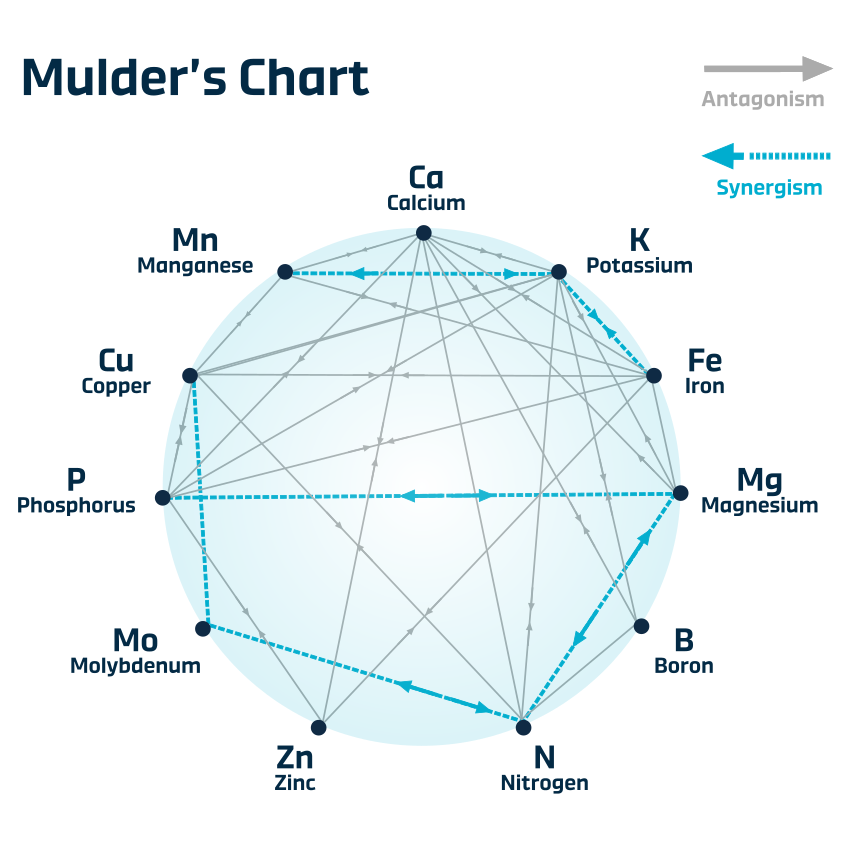
- Synergy: Calcium and magnesium work together to support strong growth, photosynthesis and efficient nutrient use.
- Competition: Calcium, magnesium and potassium are all positively charged cations that compete for soil exchange sites and root uptake.
- Takeaway: Balance is more important than maximizing any one nutrient.
The goal isn’t maximizing one nutrient; it’s maintaining balance so all three remain available throughout the season.
ICL Solutions
Building balance with innovative solutions
Rather than managing calcium and magnesium as isolated inputs, ICL nutrition programs are designed to supply complementary nutrients together.
- Polysulphate® — season-long calcium and magnesium
Polysulphate naturally supplies sulfate sulfur, potassium, calcium and magnesium in a single granule. Because it releases nutrients gradually, it helps maintain nutrient availability throughout the season while reducing the risk of loss through leaching. ICL research has shown that supplying sulfate-based calcium and magnesium together through Polysulphate supports improved nutrient efficiency alongside season-long sulfur and potassium.
- Nova FLOW® — magnesium during peak demand
During rapid growth, crop demand can outpace what roots can supply. Nova FLOW delivers readily available potassium together with magnesium, sulfur and boron, making it a strong fit when tissue testing identifies an in-season magnesium shortfall. We typically recommend pairing this with soil-applied Polysulphate for season-long nutrient synergy and support or with foliar applied Nova PULSE® for mid-season success.
- Agrolution pHLow® — pH management with nutrient boost
High pH and alkalinity in irrigation waters and soils can limit uptake and nutrient availability. When growers need both essential nutrients and pH management, fertigation products like Agrolution pHLow High K Plus Ca and Agrolution pHLow High K plus Mg are an ideal, well-balanced choice.
Real World Results
What this looks like in the field
- Potatoes: Calcium and magnesium both influence tuber quality and internal defects. Across North American trials, Polysulphate has improved marketable yield and nitrogen-use efficiency. In one Wisconsin study, pre-plant Polysulphate combined with mid-season Nova FLOW® increased yield by 17.5%.
- Cotton: Potassium, magnesium and sulfur demand peaks during flowering and boll fill. In Georgia trials, Polysulphate® plus Nova FLOW® increased lint yield by 38% over the non-foliar control, with Georgia and Texas trials averaging roughly 20% higher yield.
- Apples: Consistent calcium availability during fruit development, alongside balanced potassium and magnesium nutrition, is key to reducing bitter pit and other storage disorders in Honeycrisp. In Michigan and New York trials, Polysulphate increased marketable yields.
Agronomist Takeaway
Calcium and magnesium do their best work as a team, not as standalone inputs. Understanding where they support each other—and where they compete with potassium for the same limited uptake capacity—helps build fertility programs that close nutrient gaps instead of chasing single-nutrient fixes. Solutions like Polysulphate® and Nova FLOW® are built around that systems approach, delivering complementary nutrients that support nutrient uptake, crop health and yield potential together.
Frequently Asked Questions
Is there an ideal calcium-to-magnesium ratio?
There isn’t a single calcium-to-magnesium ratio that fits every soil or crop. Soil texture, cation exchange capacity (CEC), potassium levels and crop requirements all influence how these nutrients behave. Rather than basing decisions on one universal ratio, focus on maintaining balanced nutrition using soil and tissue tests to identify potential imbalances before they limit crop performance.
Can too much potassium cause magnesium deficiency?
Yes. Potassium, calcium and magnesium are all positively charged cations that compete for uptake by plant roots. Excessive potassium applications can reduce magnesium uptake, even when soil magnesium levels appear adequate. Tissue testing can help confirm whether crop uptake—not just soil supply—is becoming limiting.