Whatsapp
  X
X  Mail
Mail  Copy link
 Correct Mid-Season Nutrient Gaps to Protect Potato Yield

On this page:
Mid-Season Nutrient Challenges in Sandy Soil Potatoes
Potato crops grown on sandy soils often establish well early in the season but face increasing nutrient efficiency challenges as demand rises and availability falls. Mid-season is a critical period, as nitrogen and magnesium are more prone to loss and soil uptake alone may not keep pace with crop needs.
In a 2025 Washington potato field, a grower observed strong early growth but became concerned about whether the crop could maintain yield potential through tuber bulking and harvest. ICL agronomic support stepped in to help diagnose the issue and identify options to stabilize nutrient availability mid-season.

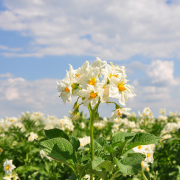
Washington potato field at time of application
Identifying Nutrient Limitations with Tissue Sampling
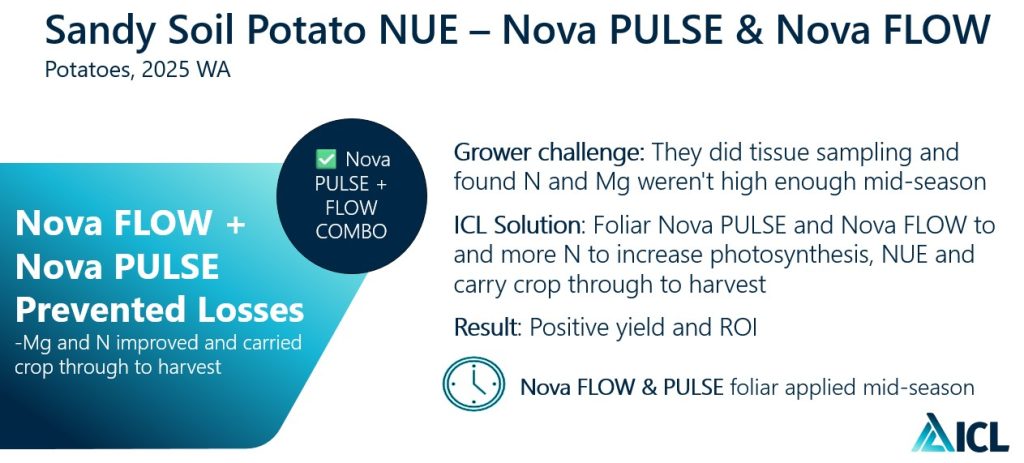
To better understand crop status, the grower conducted mid-season tissue sampling. Results showed:
On sandy soils, low N and Mg can quickly limit photosynthesis, reduce nitrogen use efficiency (NUE), and slow crop momentum during one of the most demanding growth stages.
The ICL Mid-Season Foliar Solution
To stabilize crop nutrition and prevent further losses, the grower worked with their retailer and our agronomist to implement a mid-season foliar program with Nova PULSE® and Nova FLOW®.
Mid-Season Foliar Strategy with Nova PULSE® and Nova FLOW®
- Nova PULSE® supported nitrogen efficiency and crop energy, helping sustain growth during peak demand
- Nova FLOW® supplied magnesium to strengthen chlorophyll function and photosynthetic capacity
Both products were foliar applied mid-season, enabling rapid correction of deficiencies identified through tissue testing
On-Farm Observations Following Foliar Application
Yield and Return on Investment Results
The mid-season foliar nutrition resulted in increased green color visually, which matched the positive tissue analysis. It was critical to carry the crop through the season for potato yields and economic returns at harvest.
How can foliar applications help with mid-season deficiencies?
Mid-season foliar treatment with Nova PULSE® and Nova FLOW®, can support:
- Improved N and Mg tissue levels
- Stronger photosynthetic activity
- Improved nutrient use efficiency
- Growth momentum through harvest
By responding to tissue test data with Nova PULSE® and Nova FLOW®, growers can correct nutrient limitations, improve NUE, and protect yield potential when it matters most.
Agronomist Tip: Enhancing Nutrient Uptake and Efficiency in Potatoes
While mid-season foliar nutrition is an effective tool for supporting nutrient demand and correcting in-season deficiencies, we can maximize nutrient performance by supporting soil conditions and nutrient availability throughout the season—especially on sandy soils.
To help maximize nutrient uptake and efficiency, we often recommend a complementary approach:
- Polysulphate® Granular, soil-applied, provides season-long sulfur, magnesium, potassium, and calcium in a natural, low salt sulfate-based form. Its gradual nutrient release supports balanced nutrition and soil health.
- BIOZ® Diamond acts as a liquid microbial food source, supporting soil biology and nutrient cycling to help improve root access to applied nutrients.
- Agrolution pHLow® (various formulations) or Nova PeKacid® helps acidify the root zone, improving phosphorus availability with additional nutrients to support tuber quality. Available in water-soluble or liquid form.
- As bulking progresses, Nova FINISH® can be positioned mid/late-season to deliver higher potassium (K) via foliar application or fertigation, supporting overall crop balance and tuber development.
By using a proactive approach, combined with soil and tissue testing, we can get ahead of deficiencies and mitigate risk. Integrating soil-applied, fertigation and targeted foliar applications we can help create conditions where nutrients are used more efficiently, supporting consistent crop performance through tuber initiation, bulking and harvest.
Looking to add foliars to your crop nutrition program? Contact a local expert to learn more.


Related Crop