Whatsapp
  X
X  Mail
Mail  Copy link
 Phosphorus 101: Why Phosphorus Fertilizer Is Essential for Roots, Shoot and Yields

On this page:
Phosphorus Fertilizer — Essential for Roots, Shoots & Yields
Phosphorus sets the pace. It powers roots, energy, and reproduction—and the first 30–40 days decide most of the story. Nail P early and crops accelerate; miss it, and you rarely catch up, no matter how much you add later.
This guide explains what phosphorus does in the plant, how soil tests can mislead, and the field proven levers—pH, placement, and precision—that maximize phosphorus use efficiency (PUE) with less waste.
What Is Phosphorus—and Why Does It Matter?
Phosphorus is an essential chemical element (symbol P) and one of agriculture’s three primary macronutrients—nitrogen, phosphorus, potassium (NPK). It plays uniquely important roles in energy, roots, and reproduction.
P is essential for:
- Energy transfer (ATP): Part of the cellular energy currency that powers photosynthesis and growth.
- Root system development: Drives early root initiation, branching, and root hair density—improving water and nutrient uptake.
- Reproductive success: Supports flowering, fruit or seed set, and grain fill for yield and quality.
- Whole plant vigor: Promotes canopy closure, water use efficiency, and uptake of N, K, and micronutrients.
Bottom line: Without enough early season P, crops often cannot reach full yield potential—even if more fertilizer is added later.
How Do Crops Take Up Phosphorus?
How plants absorb P: Roots take up P as orthophosphate ions in the soil solution. Because P moves slowly in soil (diffusion limited), seedlings only access what is very close to the root—especially in cold soils.
→ That’s why starter P and banding are so effective.
Nuances that matter:
- Inside the plant: P is phloem mobile, so deficiency symptoms tend to appear first on older leaves. Cold or compacted soils can mask symptoms.
- Rhizosphere helpers: Healthy roots and soil microbes release organic acids that solubilize bound P near the root surface.
Tip: Early phosphorus is the most important. Later applications rarely “catch up” if the crop starts deficient.
What does Phosphorus Deficiency Look Like?
Field cues (confirm with tissue tests):
- Growth: Stunted plants, slow early growth, delayed maturity.
- Leaves: Dark green foliage with purpling (anthocyanin), usually on older leaves.
- Roots: Sparse, shallow roots with fewer laterals and root hairs.
Crop examples
- Corn: Purpling on lower leaves; uneven stands in cool springs.
- Soybean: Stunted early growth; delayed flowering; subtle purpling on older trifoliates.
- Potatoes & cool season vegetables: Strong early response to starter P—even at moderate soiltest P.
- Almonds & fruit crops: Weak early growth and poor fruit set when P is limited; placement and water pH matter.
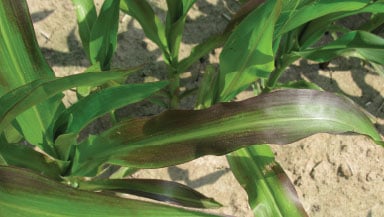
Visible phosphorus deficiency in corn leaf.

Visible phosphorus deficiency in strawberry leaf.
Why P Is Hard to Manage
What is Phosphorus Fixation & Tie-up?
The pH “sweet spot: P availability generally peaks around pH 6.0–6.8. Outside this range, P reacts with other ions to form less soluble compounds (“fixation”).
- Acidic, low pH soils → P binds to iron and aluminum (Fe/Al).
- Alkaline, high pH soils → P binds to calcium (Ca).
P is immobile in soil, so roots struggle to access it unless it’s placed nearby. Solubility is influenced by soil conditions like pH (chemical reaction).
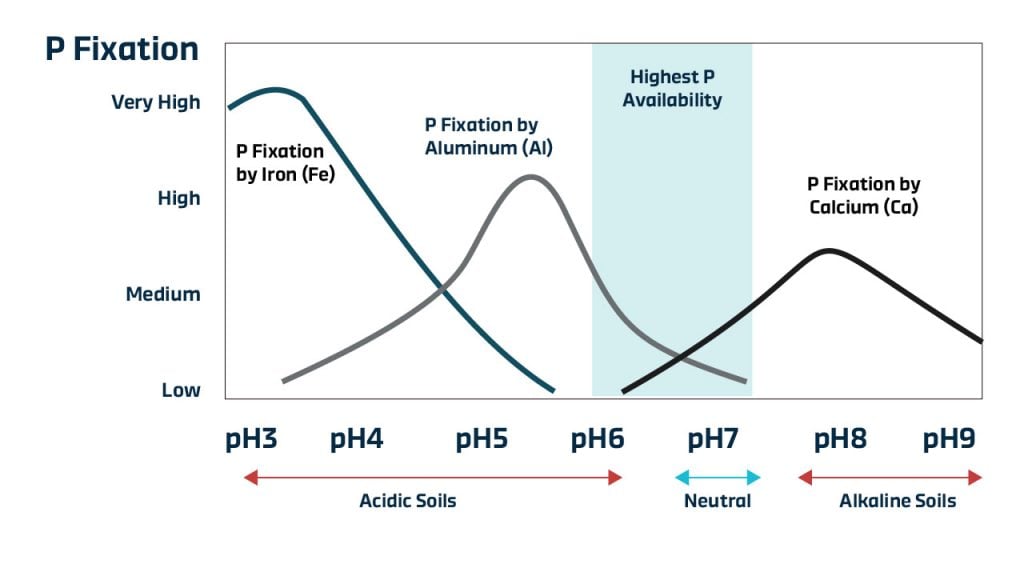
Phosphorus Fixation Chart (soil pH)
Management focus: Keep the available P near roots in soluble form to promote plant uptake, and help the fixed or organic pools release P—without overapplying fertilizer.
What you can do:
- Move soil pH toward the sweet spot with lime (acid soils) or acidifying strategies (alkaline soils).
- Create localized acidity at the application zone (banding or fertigation) using products like Nova PeKacid or Agrolution® pHLow to dissolve soil bound P.
- Encourage biology: Strengthen root and microbial activity (e.g., with BIOZ®, cover crops, and good residue management) to increase organic acid production and P solubilization.
Soil Tests: Useful—but They Don’t Tell Everything
Bray I and II and Mehlich are acid based tests. Olsen is alkaline based. The tests measure extractable P levels in the soil to provide an index of expected yield response, not an exact measure of plant available P. Always interpret results in context: pH, texture, water quality, cropping history, and placement.
- Index ≠ inventory: “Very High” means low probability for response to fertilizer but does not guarantee supply; “Low” means there is a high probability for response to fertilizer, but does not mean roots can’t access legacy P.
- Crop differences: Response may differ by crop, water quality, and soil context. Potatoes, for example, often respond to P at soil test levels considered “high” for other crops.
Avoid the “easy button” trap: Applying blanket crop removal rates year after year may overapply on some fields and undersupply others. Test before you apply—then interpret carefully.
Where Does Phosphorus Come From?
- Naturally: Weathering of rock, organic matter, and biological cycling.
- Industrial fertilizers: Mined phosphate rock (apatite) is the primary source.
- Organic sources: Decomposing plants, animal waste/manure, nutrient recovery and food waste.
What are Common P Sources? (Quick Reference)
- MAP (11-52-0) and DAP (18-46-0): Widely used granular sources; Diammonium Phosphate (DAP) is initially more alkaline near the granule, Monoammonium Phosphate (MAP) slightly acidic.
- Triple Superphosphate/TSP (0-46-0): HighP, no N; more niche today; ideal for direct application and bulk blending. ICL’s Granular triple superphosphate (GTSP) is highly water soluble.
- Ammonium polyphosphate/APP (10-34-0) & polyphosphates: Fluid sources suited for banding/row placement; polyphosphate hydrolyzes to orthophosphate.
- Potassium tripolyphosphate/KTPP: High quality, pharmaceutical grade P used in starter fertilizers like CHALLENGE.
- Acidifying soluble sources: Nova PeKacid, Agrolution® pHLow improves solubility in hard/alkaline water and high pH soils.
- Specialty granular options: ICL PKpluS (Polysulphate based granule with P + K + S + Mg + Ca) for balanced sulfate-based nutrition with added P.
Creating the Right Conditions in the Rhizosphere
How can we manage pH to improve phosphorus uptake?
Our goal is to unlock soil P and increase phosphorus use efficiency (PUE) specifically near the root zone. To do that we can:
- Manage pH toward 6.0–6.8 or create localized acidic microzones. Acidifying water-soluble fertilizers (e.g., Nova PeKacid, Agrolution pHLow) help counter bicarbonate rich water.
- Band/place P near the seed or root zone—especially in cool soils. Products like CHALLENGE support early P access and rooting.
- Use starter programs for early planting or cold soils.
- Reduce stratification in no till by strategically banding or placing P below the surface when warranted.
- Be precise: Variable rate by management zone; validate with tissue tests and strip trials.
- Enhance biological activity: Cover crops, residue management, reduced disturbance, or biological support inputs like BIOZ®.
- Follow the 4Rs: Always test first, then apply the right source, rate, time, and place for your soil and crop.
Agronomist tip: On high pH soils use sulfate-based fertilizer Polysulphate to break the carbonate chemistry dominance on Calcium. Band acidic phosphates (Nova PeKacid, Agrolution pHow) to increase P and micronutrient availability in the root zone.
When we create the right soil and pH conditions for improved phosphorus uptake we can reduce phosphorus rate and improve P efficiency and yield for both agronomic and economic benefits.
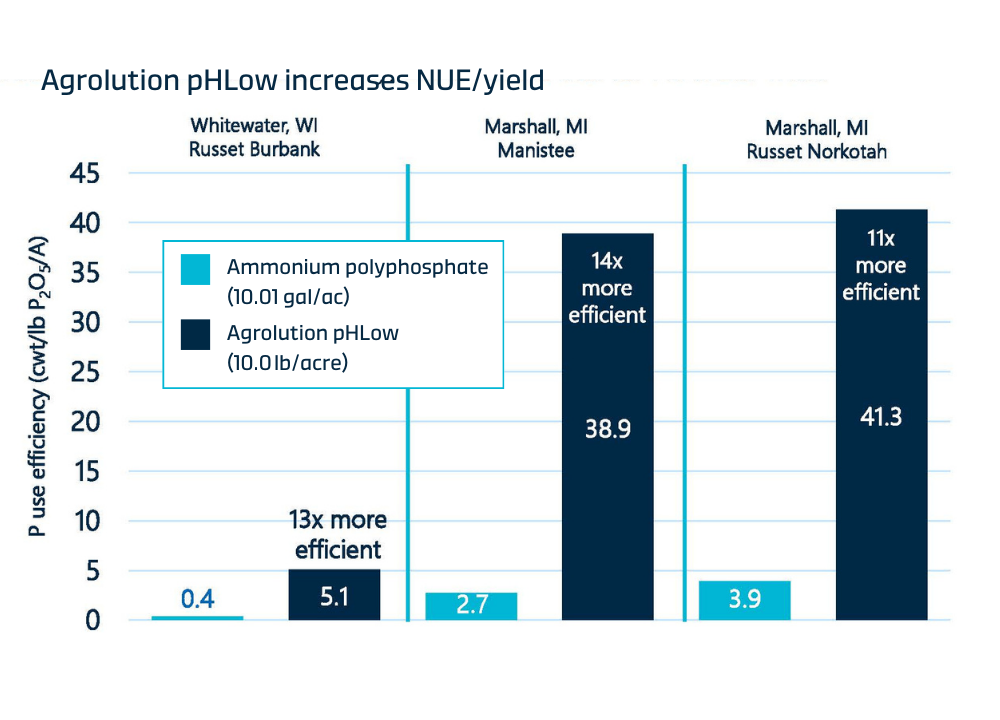
Agrolution pHLow increases phosphorus use efficiency and yield in potatoes.
Environmental & Efficiency Considerations
- P is less mobile than nitrate but can move via runoff, especially on slopes or saturated soils.
- The 4Rs protect water quality and reduce waste.
- Efficient P use preserves finite phosphate resources while supporting long-term soil productivity.
Key Takeaways
Early access to phosphorus sets yield potential. Rather than overapply phosphorus we want to manage pH and placement to make the early season P work harder—then validate with testing as needed. Whether we are applying phosphorus, or making the most of the phosphorus in our soil, the goal is create ideal conditions for efficiency and productivity. Where water/soil pH limits availability, acidifying soluble P and balanced multi-nutrients can unlock soil reserves and convert potential into yield, saving both time and money.