Whatsapp
  X
X  Mail
Mail  Copy link
 Potassium Management in Potatoes: How Mid-Season K Increased Yield by 17.5%
Potatoes are a potassium-driven crop. Learn how season-long potassium management with early-season Polysulphate and foliar applied Nova FLOW at bulking improved yield with a positive ROI.
On this page:
Potassium in Potatoes: Why Gradual-Release and Foliar K applications Protect Yield
A Wisconsin potato trial significantly increased yields and delivered a 2:1 ROI simply by maintaining potassium availability through tuber bulking. The results reinforce a critical principle in potato nutrition: applying enough potassium isn’t always the same as having potassium available when the crop needs it most.
I like to compare potassium to the oil in your engine. You don’t fill it once at the start of a road trip and hope it lasts until the end. You watch and maintain levels, choose a good source, and you make sure it’s topped up when the engine is under load.
In potatoes, potassium (K) is often discussed in terms of crop removal. How much K leaves the field, and how much needs to go back. But that approach can miss the bigger picture.
Our goal is keeping the engine running the whole time.
Why Potassium Matters in Potato Production
Potassium is not just a yield nutrient; it is also a quality, transport and energy efficiency nutrient. It helps regulate water movement, sugar transport, starch formation, and crop resilience under stress.
In potatoes it can affect everything from bulking to skin quality. Tubers are simply a high potassium demand crop containing approximately 2.2–2.5% potassium on a dry matter basis.
Potassium supports both yield and quality:
- Total yield
- Tuber size and distribution
- Quality; starch, specific gravity, fry color
- Storage performance; skin quality, bruise resistance, shrink
- Stress tolerance
And that level of demand is exactly where many potassium programs start to fall short. Not because the total K isn’t there, but because it isn’t available when the crop needs it most.
The Problem with “Good on Paper” Potassium Programs
Traditionally, a lot of potato programs are front-loaded. Potassium is applied at pre-plant, maybe at high rates, and technically you’ve met crop removal. On paper, everything looks right, but potatoes don’t use potassium evenly through the season.
Demand spikes as the crop moves into:
- Flowering
- Tuber initiation
- Bulking
And that’s where things start to break down. Because potassium can be fixed in the soil and uptake restricted, early applications don’t always translate into consistent access later, especially if conditions limit uptake.
Why Potassium Timing Matters in Potatoes
At flowering (60–70 days after planting), petiole potassium levels should be at their highest. This is when the crop is rapidly moving nutrients into tuber development.
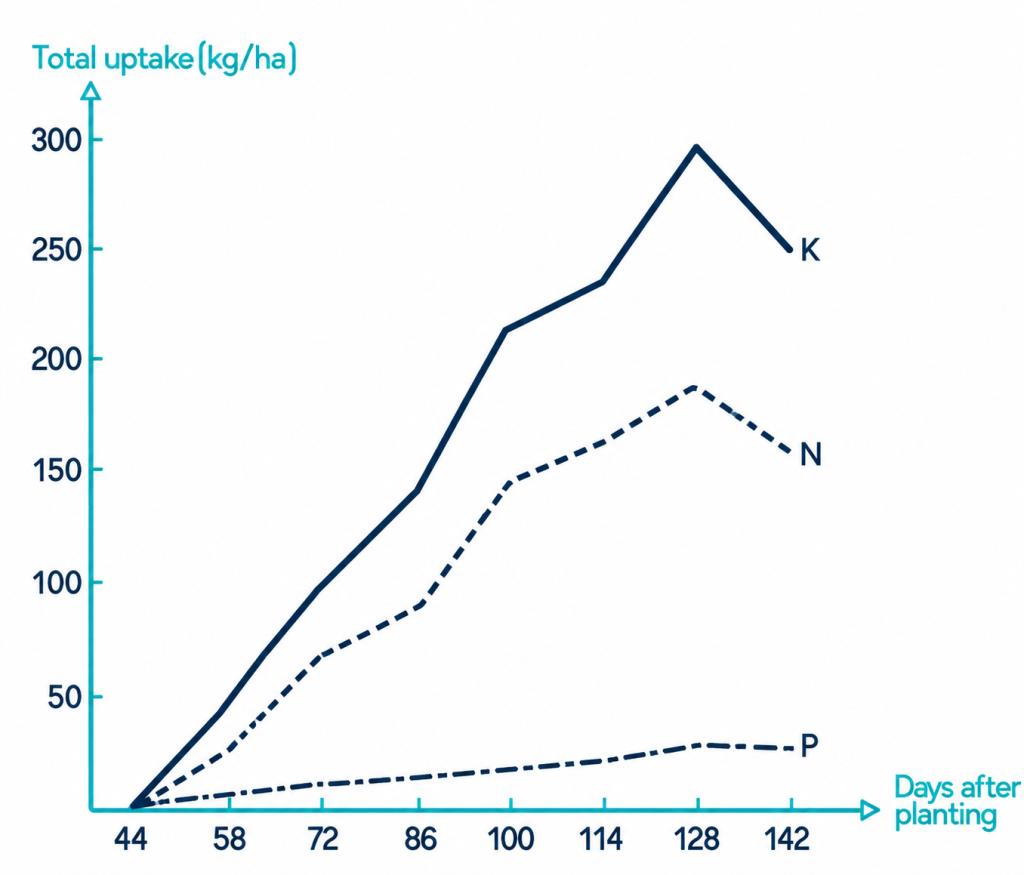
Even in a field where “enough K” was applied, the crop can still run short when it matters most. And once that happens, potential yield is already limited and you don’t get it back.
Agronomist note: Petiole testing improves decisions. Petiole testing and field-specific calibration help build a stronger field intelligence system. Tracking potassium through the season can improve timing and application decisions year after year.
Potato Potassium Trial: Can Season-Long K Availability Improve Performance?
To test this, a field trial in Whitewater, Wisconsin, evaluated the impact of maintaining potassium availability through the season by including foliar potassium at bulking.
Treatments
- Grower standard (pre-plant K focused program)
- GSP + Polysulphate at pre-plant (360 lb/A)
- GSP+ Polysulphate at pre-plant + Nova FLOW (3 lb/A in-season)
Product analyses
- Polysulphate: 0-0-14 + 3.6 Mg + 19 S
- Nova FLOW: 5-10-20 + 11 S + 9 Mg + 0.5 B
The Result: Mid-Season Potassium Availability Paid Off Even in Low Price Conditions
An early-season soil application of Polysulphate followed by a foliar potassium application of Nova FLOW during bulking increased yield by 73 cwt/A, delivering a 2:1 ROI even under low potato price conditions.
We can see the difference showed up clearly in yield:
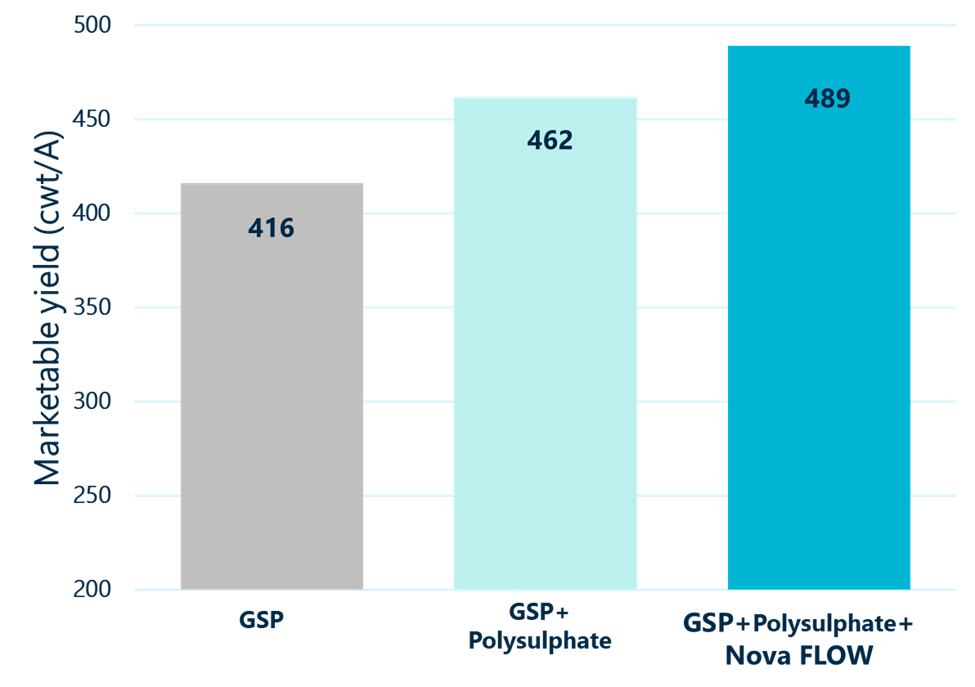
- Polysulphate increased yield by 46 cwt/A (11% more) relative to the GSP
- Adding Nova FLOW (foliar at bulking) increased yield by an additional 27 cwt/A (5.8% more) relative to Polysulphate+GSP
Total yield increased by 17.5% using Polysulphate broadcast in the spring, paired with Nova FLOW foliar at tuber bulking.
Same crop. Same field conditions. The main difference was how potassium was managed across the season and the additional synergy between K and Mg.
What Changed? It Wasn’t Just the Rate—It Was the Timing
This trial wasn’t about simply adding more K. It was about efficiency and keeping K available when the crop needed it most.
- Early season = Filling the tank: Polysulphate provided a solid base to build the system—supplying potassium gradually and helping establish the crop. That’s your oil fill at the start of the trip.
- Mid to late season = Keeping the engine running: As the crop moved into bulking, Nova FLOW helped maintain nutrient flow:
- Supporting continued uptake
- Keeping leaves active
- Sustaining carbohydrate movement into tubers
Agronomist note: Nova FLOW brings a double benefit of late season potassium and magnesium. Because of the high synergy of K and Mg this stage of application helped move sugars into tubers for optimal results.
If you are looking to evaluate season-long potassium strategies in your potato program, connect with an ICL expert to discuss Polysulphate and Nova FLOW recommendations for your operation.
Best Practice for Potassium Management in Potatoes
Potassium should be managed as a season-long supply, not a one-time application. This trial highlights a consistent principle: potassium timing and availability directly influence performance during the most critical growth stages.
Late-season foliar potassium can help maintain leaf greenness and support tuber bulking under stress, but it doesn’t replace early or soil-applied potassium. It works best as protection under stress during late bulking, not as a substitute for a strong foundational program.
Likewise, instead of the crop hitting a mid-season drop-off, foliar-applied K helped maintain supply and reduce risks of deficiencies during peak demand.
A Different Way to Think About Potassium
The question isn’t “Did I apply enough K?” It’s “Was K continuously available when the crop needed it?”
A solid soil-applied K program is essential, but the data indicates to us it’s only the starting point. This trial showed that maintaining availability throughout the season, especially during tuber bulking, is what protects yield. In-season tools don’t replace your foundation, but they do help ensure it performs when demand peaks.
As I like to say, a strong potato crop does not reach the finish line by chance, it gets there by keeping the engine running all season long.
Explore Polysulphate and Nova FLOW solutions or contact an ICL agronomist to discuss season-long potassium management strategies for your potato acres.


Learn More