


 Whatsapp
  X
X  Mail
Mail  Copy link
 Storing Growing Media and Potting Times with Peat-free Substrates
The rapid shift toward peat-reduced and peat-free growing media adds complexity: more components mean more variability. Also storing the substrate and identifying the right potting time are among the variables to consider.
On this page:
Different Raw Materials Influence how Growing Media Behaves
Not long ago, growing substrates were straightforward: peat, sometimes clay, lime, fertilizer, and a wetting agent. Today’s substrates mixes are far more advanced. They often include multiple raw materials, nitrogen to balance wood‑based components, additional Osmocote to reduce nutrient leaching, and extra wetting agents to improve water absorption.
When everything is balanced correctly, modern growing media perform just as well as traditional peat‑based mixes. But with more components comes more variability and more impact on plant growth. Each ingredient influences the substrate differently, and even small inconsistencies can create problems later in the crop cycle.
Ornamental plant growers need to be able to ask the right questions when planning the substrate mix to use. For a deep dive on the specific characteristisc of peat substitutes, have a look to our guide to peat alternatives, where we explore the properties of wood fiber, coir, bark or green compost. This other article is an overview of the key considerations a professional plant grower should evaluate when reducing or eliminating peat.
Why Storing Growing Media With Peat Alternatives Is More Complex
Proper storage has always been a challenge, but it becomes even more critical with modern, additive‑rich substrates. As the industry moves away from peat, it’s important to understand that these new mixes do not improve with age. In fact, storing growing media, especially those containing wood-based materials, compost, abrk and fertilizers almost always leads to a rise in EC over time.
Unlike chemically inert Sphagnum peat, organic alternatives (e.g., composted bark, wood fiber, green compost and coir) are biologically active, dynamic matrices. Blending them with fertilizers creates an active biochemical system that continues to react during storage.
Key storage risks include:
- microbial activity and N-immobilization: unstable wood fibers with high C:N ratios fuel microbial activity, leading to nitrogen immobilization (N-fixation) or unpredictable organic N-mineralization.
- pH instability: microbial respiration and ammonium nitrification release H+ ions, driving pH fluctuations and disrupting cation balance (e.g., Ca2+/Mg2+ displacement in raw coir).
- CRF pre-release and high EC: moisture in stored media hydrates CRF releasing NO3–, NH4+, K+, and PO43- via osmotic diffusion. Without active plants to absorb nutrients, soluble salts accumulate, causing severe Electrical Conductivity (EC) spikes.
- surfactant degradation: non-ionic wetting agents degrade chemically or biologically over time, causing hydrophobicity, loss of water absorption and uneven re-wetting.
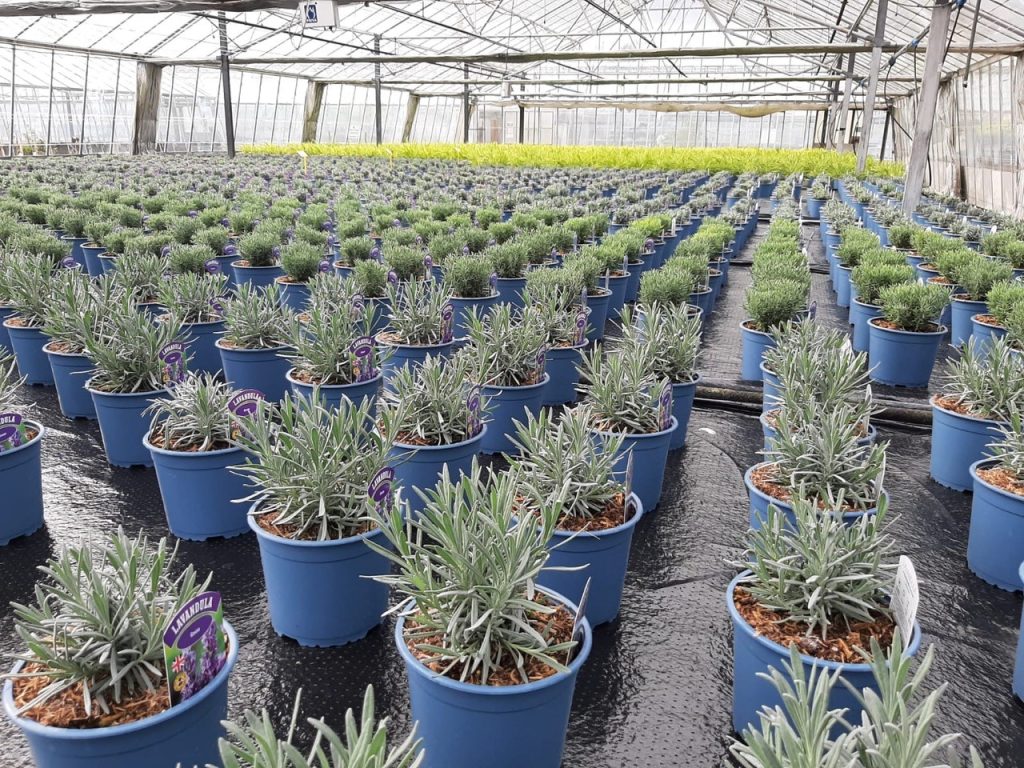
Lavender grown in wood-fiber based substrate
Potting Schedules: A Better, More Reliable Approach
Choosing the right potting time is just as important as choosing the right substrate. With modern peat-free and peat-reduced growing media, potting schedules may need to be reviewed. Unlike traditional peat-based substrates, these growing media continue to change over time. As a result, the gap between substrate production and active root growth becomes increasingly important.
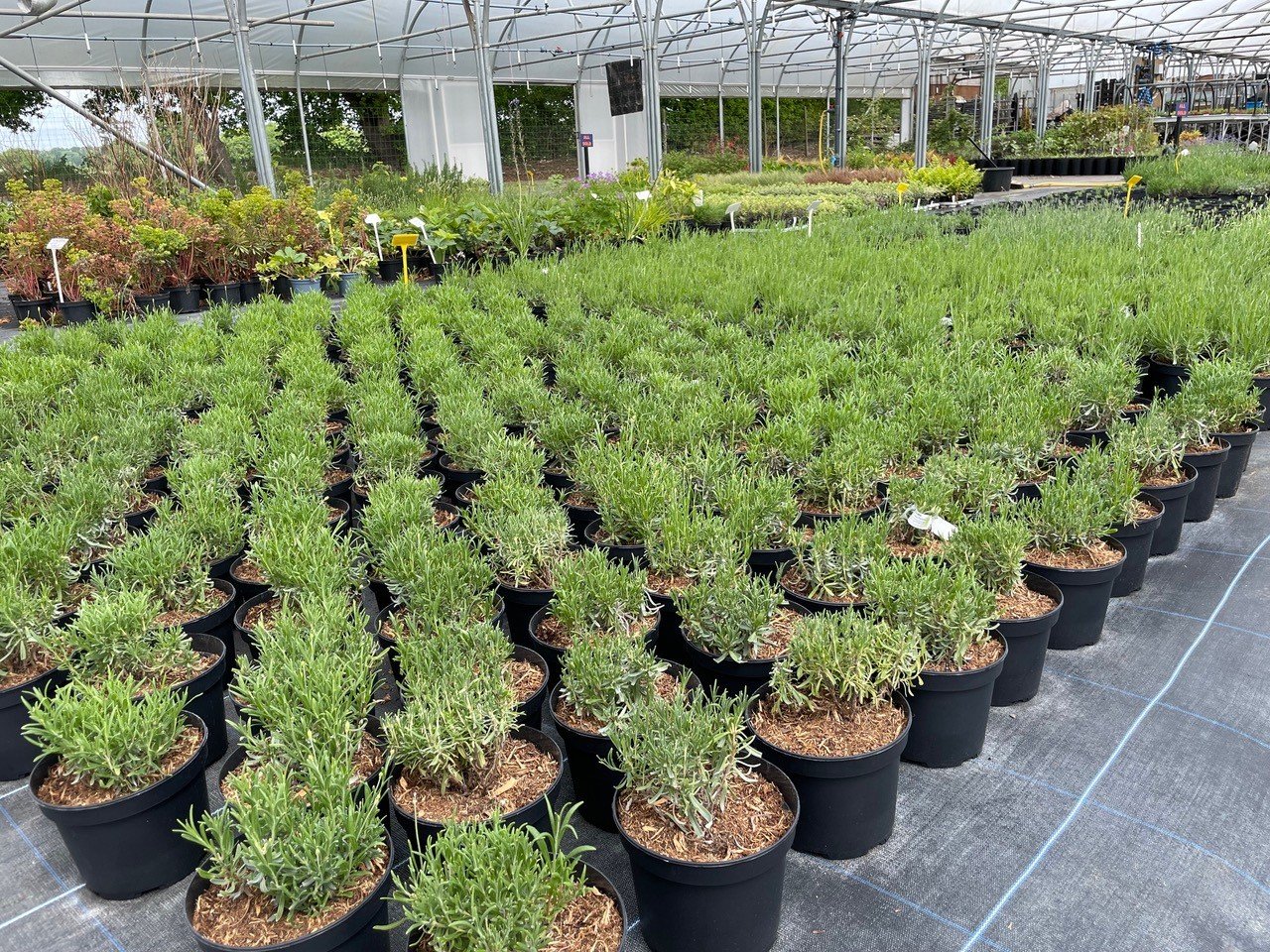
Lavander grown on peat-free substrate
Sensitive crops such as Choisya, Skimmia, Lavender and Daphne produce little or no new root growth during winter. When potted too early, they remain for months in a substrate that continues to age while EC gradually increases. By the time temperatures rise and growth resumes in spring, roots must establish in media that is no longer fresh and may contain higher salt levels. This can lead to:
- osmotic stress, reducing root growth and nutrient uptake;
- poor oxygen availability in wet, inactive root zones;
- greater susceptibility to root diseases such as Pythium, Phytophthora, and Rhizoctonia;
- slow establishment, stunting, or crop losses when growth resumes.
Once root establishment is compromised, recovery is often limited.
To reduce these risks, align potting schedules with plant development and substrate freshness rather than fixed calendar dates:
- pot in early spring, when temperatures rise, day length increases, and active root growth resumes.
- use fresh growing media, ideally within 7-14 days of manufacturing, to maintain low EC and optimal physical properties.
- match nutrient release with plant demand, allowing actively growing roots to absorb nutrients as they become available.
- promote faster, more uniform rooting, improving water and nutrient efficiency while reducing the need for corrective treatments.
Potting when plants are physiologically ready to grow helps ensure that roots establish in fresh, stable, low-EC growing media, maximizing the performance of modern peat-free and peat-reduced substrates.
Conclusion
These subjects might be complex therefore, for personalized guidance, contact your regional technical support by visiting your country’s website or fill in the form you can reach from the banner at the bottom of this page.




Our knowledge
Tips & tricks, disease prevention, crop and market related information
Explore our knowledge