


 Whatsapp
  X
X  Mail
Mail  Copy link
 How Roots Absorb Water and Nutrients: Understanding Uptake Mechanisms
Learn the key processes that drive water and nutrients through ornamental crops and the rootzone conditions that influence uptake efficiency

On this page:
How Roots Connect the Plant to Its Resources
Understanding how roots support plant growth helps proper root management, a fundamental skill for ornamental plant growers.
Crops depend on a continuous supply of water and essential mineral nutrients for growth and development andf roots are the main medium through which these resources enter the plant, but uptake is far more complex than simply absorbing what is present in the growing medium.
Water and nutrients follow different pathways and are influenced by a range of biological, chemical and physical processes.
“Water and nutrient movement into and through the plant, depends on the interaction between root structure, root activity, and the conditions within the rootzone”
| Roots Water UpTake | Roots Nutrient UpTake |
|---|---|
| Water uptake is closely linked to the water status of both the plant and the growing medium. | Nutrient uptake is selective, because nutrients must first be present in a form that roots can absorb. |
| Under normal conditions, transpiration from the leaves creates a pulling force that draws water from the rootzone, through the roots, and upwards towards the shoot. | Only under this condition, nutrients can move through the growing medium to the root surface. |
| Other processes, such as root pressure, can also contribute to water movement under specific conditions. | Once they reach the root surface, they finally cross root cell membranes through specialized transport systems. |
Many of these transport processes require energy supplied by root respiration.
The efficiency of water and nutrient uptake is influenced by several rootzone factors, including moisture content, oxygen availability, temperature and pH.
The area immediately surrounding the roots, known as the rhizosphere, plays a particularly important role because root activity, respiration, nutrient uptake and interactions with microorganisms can alter local chemical conditions. As a result, the amount of water or nutrients present in a growing medium does not necessarily reflect how much is actually available to the plant.
Understanding how water moves through plants, how nutrients reach and enter the roots, and how rootzone conditions affect these processes helps growers make better decisions to support root activity and overall crop performance.
Processes that Influence Roots Water UpTake
1. How Do Roots Absorb Water?
Water uptake occurs primarily through young root tissues and root hairs. Water moves in response to differences in water potential. In simple terms, water tends to move from a region where it is more freely available towards a region where it is less freely available. The concentration of dissolved substances contributes to this gradient. Because root cells contain dissolved solutes(such as nutrients and sugars), water can enter root cells through osmosis when the appropriate water-potential gradient exists. However, water uptake is not determined by osmosis alone. The movement of water through the plant is strongly influenced by transpiration.
2. What Drives Water Movement Through the Plant?
Under normal growing conditions, transpiration is the main driver of long-distance water movement. Water evaporates from the leaves through stomata, creating a continuous pull through the plant’s water-conducting system. This transpiration stream draws water from the growing medium, through the roots and into the xylem, from where it is transported towards the leaves and other above-ground tissue (see the article about root structure). The process therefore connects conditions at the root surface with water loss from the shoot. When transpiration is high, water demand can be substantial. When transpiration is low, other processes can contribute more noticeably to water movement.
3. The Role of Root Pressure in Water Transport
Roots can also generate root pressure. When roots actively accumulate ions, the concentration of solutes within the root can increase. Water then enters through osmosis, generating pressure within the xylem. Root pressure can contribute to upward movement of water, particularly when transpiration is low, such as during the night or under conditions of high humidity. One visible consequence can be guttation, when droplets of water appear at leaf tips or margins. Root pressure, however, is generally considered a secondary driver compared with transpiration under normal conditions.
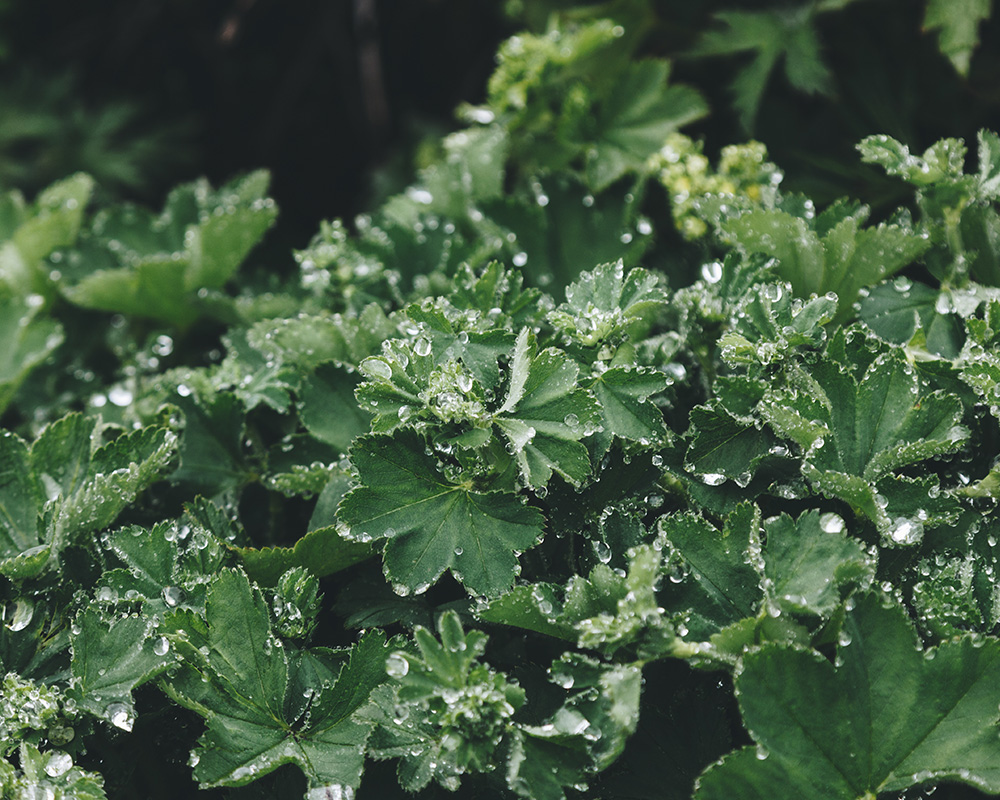
Droplets of water as the effect of gutattion in Alchemilla
4. Factors Influencing Water Uptake in the Rootzone Environment
A seen for other root processes (for example root respiration), also water uptake depends on both the plant and the environment surrounding its roots. Important factors include:
- substrate moisture content
- oxygen availability
- root-zone temperature
- concentration of dissolved salts
- root activity and development
As the growing medium becomes increasingly dry, water becomes more difficult for roots to obtain. High concentrations of dissolved salts can have a similar effect by lowering the water potential of the root-zone solution. This can make water less readily available to the plant even when the growing medium still contains measurable moisture. This is one reason why substrate moisture alone does not always provide a complete picture of plant water availability.
Processes that Influence Roots Nurients Uptake
1. How Roots Take Up Nutrients
Mineral nutrients are absorbed primarily as dissolved ions. Before a nutrient can be taken up by the root, it generally needs to be present in the root-zone solution in a form that is accessible to the plant. Nutrients in a fertilizer or growing medium are therefore not automatically available simply because they are present. Nutrient uptake occurs primarily through young root tissues and root hairs, where the root is actively interacting with the surrounding solution.
2. How Nutrients Cross the Root Membrane
Root cells contain cell membranes that regulate the movement of substances into and out of the cell. Specialized membrane transport proteins and allow roots to take up particular nutrient ions. Some movement can occur according to concentration or electrochemical gradients, while other forms of nutrient uptake require active transport which, in turn, requires metabolic energy.
This is where root respiration becomes directly connected with nutrient uptake. When oxygen availability is reduced and respiration is restricted, the energy supply available for energy-dependent transport processes can also be affected. The relationship between oxygen and nutrition becomes clear: an active root needs sufficient oxygen to maintain the metabolic processes required for efficient nutrient acquisition.
3. How Nutrients Reach the Rootzone and Root Surface
Nutrients in the growing medium can reach the root surface through several mechanisms.
- Mass flow
Mass flow occurs when dissolved nutrients are transported towards the roots with the movement of water. As plants take up water, the resulting flow can bring dissolved ions towards the root surface. The importance of mass flow varies between nutrients and depends on water movement and nutrient concentration in the root-zone solution. - Diffusion
Diffusion is the movement of ions down a concentration gradient, from an area of higher concentration towards an area of lower concentration. When roots remove a nutrient from the surrounding solution, its concentration close to the root can decrease. This can create a gradient that drives further movement of the nutrient towards the root. - Root growth
Growing roots also contribute directly to nutrient acquisition. As roots extend and branch into new areas of the growing medium, they encounter previously unexplored zones containing water and nutrients. Root growth therefore increases access to resources independently of the movement of nutrients through the existing root-zone solution.
4. Why pH Shapes Nutrient Availability and Uptake
Nutrient uptake is strongly influenced by the chemical conditions around the roots. One of the most important factors is pH. The availability of different nutrient ions changes with pH, meaning that a nutrient may be present in the growing medium but not necessarily available to the plant in the same way under all pH conditions.
The area immediately surrounding the roots is known as the rhizosphere. This is not simply the substrate surrounding the root. It is a biologically and chemically active zone influenced by root respiration, nutrient uptake, compounds released by roots and interactions with microorganisms. As a result, chemical conditions in the rhizosphere can differ from those measured in the bulk growing medium.
5. Why Nutrient Availability Does Not Always Mean Nutrient Uptake
As per water, also when it comes to nutrients, their presence in the growing medium does not automatically mean that the plant can absorb it. Nutrient uptake depends on several interacting factors, including:
- nutrient concentration
- nutrient form
- pH
- root activity
- oxygen availability
- temperature
- moisture
- salt concentration
- interactions and balance between nutrients
A nutrient can therefore be chemically present but physiologically unavailable, or its uptake can be restricted because the root system is not functioning effectively. This distinction is particularly important in intensive ornamental production, where fertilizer programmes are closely linked to crop growth and quality.
The root system is continuously interacting with its environment rather than simply taking resources from a passive substrate. Efficient uptake depends on maintaining conditions that allow roots to remain active.
Conclusion
Roots functions, roots structure and root respiration: together with roots uptake mechanisms are the articles aimed to boost technical knowledge around this fascinating subject. Growing ornamental plants with a well developped and healthy root system is a precondition for sucessful ornamental horticulture. You can find the links below.







Our knowledge
Tips & tricks, disease prevention, crop and market related information
Explore our knowledge