


 Whatsapp
  X
X  Mail
Mail  Copy link
 Nutrient Interactions: Why Balance Matters More Than Quantity
Ornamental plants' economic value depends on their appearance: colour, uniformity, compactness, flowering behaviour. Even small nutritional imbalances can influence these traits. Antagonism and synergism suggest how nutrients interact with one another.
On this page:
Some nutrients support each other’s uptake, while others compete. When these relationships fall out of balance, plants may show chlorosis, uneven growth, delayed flowering, or reduced overall quality, even if the fertilization program looks correct on paper.
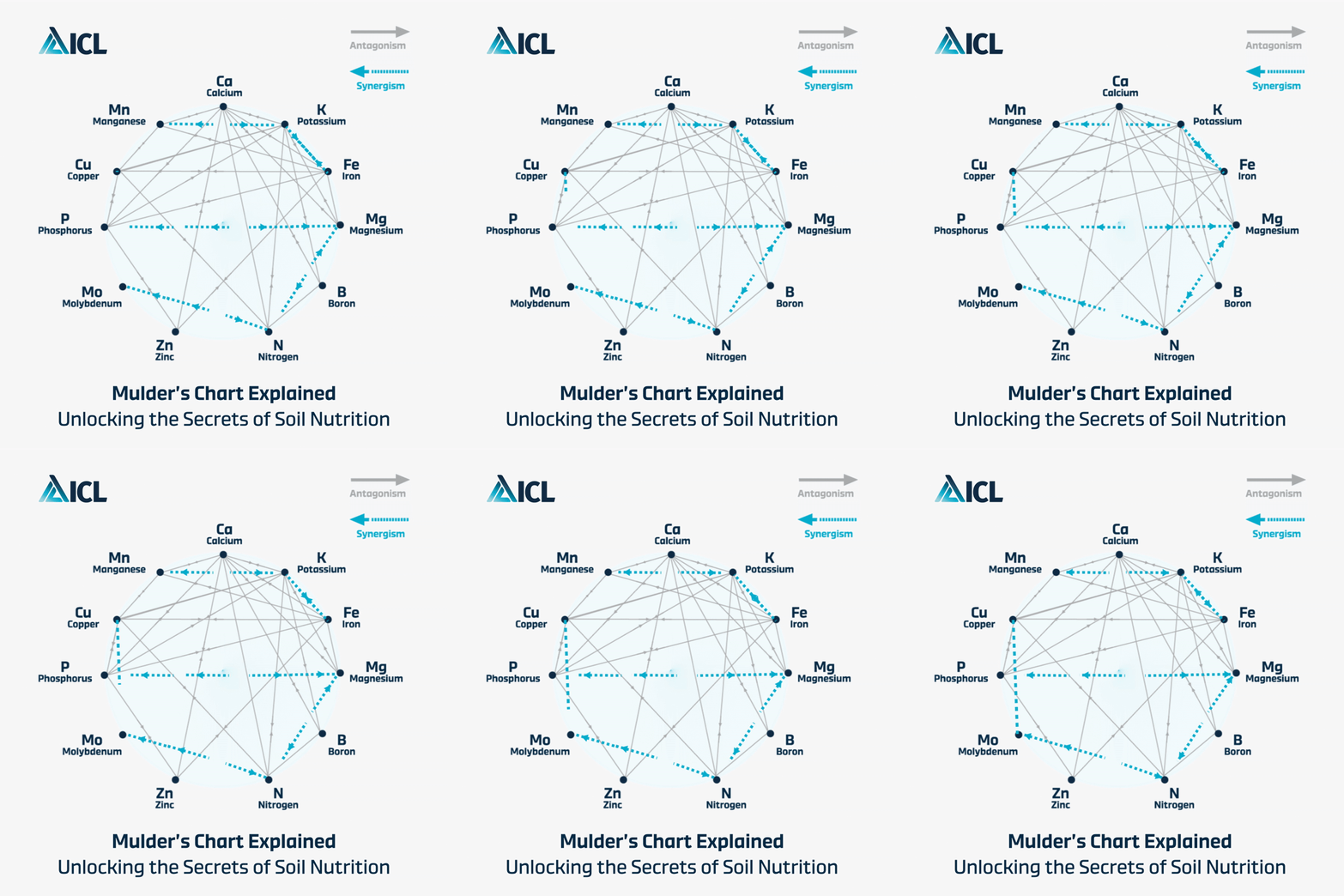
A useful way to visualise these relationships is Mulder’s Chart, developed in the early 1950s by Dutch scientist Derk Mulder. His diagram mapped the positive and negative interactions between nutrients — a concept that was groundbreaking at the time and remains highly relevant for modern plant nutrition. Despite its age, Mulder’s Chart is still one of the clearest tools for understanding why balanced nutrition matters.
Why Nutrient Interactions Matter in Ornamental Horticulture
Ornamental crops rely on precise nutrient ratios. Too much of one nutrient can block another; too little can limit growth even when everything else is optimal.
Two types of interactions shape plant nutrition:
- Synergy – nutrients that support each other’s uptake or function.
- Antagonism – nutrients that compete or interfere with one another.
Understanding these relationships helps growers prevent “hidden hunger” and maintain consistent visual quality.
What Happens Chemically: Competition, Charge, and pH
Ionic competition at the root surface
Many nutrients share the same transport pathways. Cations such as K⁺, Ca²⁺, and Mg²⁺ often compete for uptake. When one is present in excess, it can physically block the “doorway” for another.
pH and sorption capacity
Nitrogen fertilization, especially in ammonium form, can acidify the substrate. As pH shifts, the substrate’s ability to hold and release nutrients changes. This affects the availability of alkaline cations like Ca and Mg and can trigger deficiencies even when total nutrient levels are adequate.
These chemical processes explain why nutrient problems often appear suddenly and without an obvious cause.
Synergy: When Nutrients Work Together
Balanced nutrition creates positive interactions that support healthy growth, colour, and flowering.
Examples of synergistic relationships include:
- nitrogen ↔ magnesium – magnesium supports chlorophyll formation, and nitrogen increases the plant’s demand for Mg during active growth.
- magnesium ↔ phosphorus – these two elements often move together in energy‑transfer pathways.
- potassium ↔ manganese/iron – adequate potassium supports the uptake and mobility of Mn and Fe, which are essential for strong colour and photosynthesis.
- sulfur ↔ N, K, Mg, Cu, Mn – sulfur plays a central role in enzyme activation, improving the efficiency of several other nutrients.
Synergy is one of the reasons why balanced fertilization often produces visibly stronger, more uniform crops than high‑input programs.
Antagonism: the Hidden Cause of Many Deficiencies
Antagonism occurs when one nutrient suppresses the uptake of another. This is especially common in substrates with low buffering capacity.
Key antagonistic relationships include:
- phosphorus ↔ zinc, iron, copper, calcium, potassium – excess P is one of the most common causes of micronutrient lock‑up.
- calcium ↔ K, Mg, NH₄‑N, Mn, Zn, B, P, Fe – high Ca can block several nutrients, especially in hard‑water regions.
- nitrogen ↔ potassium, copper, boron – according to Mulder’s Chart, high N can reduce the uptake of K, Cu, and B.
- iron ↔ manganese – these two elements frequently compete, leading to chlorosis or mottling depending on which one dominates.
- copper ↔ zinc – excess Cu can suppress Zn uptake, resulting in stunting and pale foliage.
These interactions explain why deficiencies often appear even when the nutrient is present in the substrate – the plant simply cannot access it.
Recognising Induced Deficiencies in Ornamentals
Nutrient interactions often produce characteristic symptoms:
- interveinal chlorosis → Fe/Mn antagonism
- delayed flowering → imbalances in NPK or micronutrients such as B and Zn
- stunted, compact growth → P‑induced Zn deficiency
- uneven colour or patchy growth → Ca/K/Mg competition
Understanding the interaction behind the symptom helps growers correct the root cause, not just the visible effect.
Practical Strategies for Growers
- Balance fertilization instead of “more is better” – over‑applying a single nutrient can create more problems than it solves.
- Monitor both substrate and leaf tissue – substrate tests show what is available; tissue tests show what the plant actually absorbed.
- Keep an eye on irrigation water quality – water chemistry influences pH and salinity, which in turn affect nutrient availability. Even a simple check of EC, alkalinity, and pH helps prevent nutrient lock‑ups.
- Stabilise micronutrient availability – using controlled, well‑formulated microelement packages, such as Micromax® Premium, helps prevent both antagonistic lock‑ups and excessive uptake.
- Watch pH trends – small pH shifts can dramatically change nutrient availability, especially for Fe, Mn, Zn, and B.
Conclusion: Nutrition as a Balanced System
Ornamental plants perform best when nutrients work in harmony. Synergism supports growth, colour, and flowering. Antagonism, when unchecked, silently blocks uptake and reduces quality.
Mulder’s Chart helps growers understand these relationships and design fertilization programs that support healthy, uniform, visually outstanding plants. Balanced nutrition isn’t about adding more – it’s about maintaining the right nutrient proportions.
For personalized guidance, contact your regional technical support by visiting your country’s website or fill in the form you can reach from the banner at the bottom of this page.

-
 How to Recognize Nutrient Deficiencies in Ornamental Plants and How to Fix Them
 - Mixing Trace Elements with Substrates: Why Use Micromax Premium
- Nitrogen Deficiency in Ornamental Plants: Symptoms and Treatment
- Potassium Deficiency in Ornamental Plants: Symptoms and Treatment
- Phosphorus Deficiency in Ornamental Plants: Symptoms and Treatment

Our knowledge
Tips & tricks, disease prevention, crop and market related information
Explore our knowledge