Whatsapp
 X
 Mail
 Copy link
Rio: Bermudagrass cultivar profile

On this page:
Rio is a seeded Bermudagrass (Cynodon dactylon) cultivar developed for high-quality warm-season turf. Combining rapid establishment, fine leaf texture and dense growth with good wear tolerance and recovery, Rio is particularly suited to sports pitches and golf courses in warm-season and transitional climates.
Rio offers good cold and frost tolerance alongside early spring green-up, extending its suitability to regions where cooler winters can limit Bermudagrass performance.
Rio has demonstrated strong results in the National Turfgrass Evaluation Program (NTEP), supported by trials at the University of Pisa in Italy.
Rio at a glance
| Species | Bermudagrass (Cynodon dactylon) |
| A-LIST cultivar | No |
| Breeding | US genetics |
| Growth habit | Stolons and rhizomes |
| Leaf texture | Fine |
| Color | Dark green |
| Key strengths | Rapid establishment, cold tolerance and early spring green-up |
| Seed Treatment | Smart Start |
| Typical uses | Golf fairways, tees, sports pitches, training grounds and lawns |
| Sowing rate | 10–15 g/m² |
| Recommended mowing height | 15–50 mm |
| Minimum soil temperature for sowing | Above 18 °C and rising |
What are the characteristics of Rio?
Rio combines the advantages of warm-season Bermudagrass with strong establishment performance and good tolerance to cooler conditions.
Its fine leaf texture, dark-green color and high shoot density help produce a uniform turf surface, while its vigorous growth supports recovery from wear during the active growing season.
Among Rio’s most valuable characteristics are its rapid germination, early spring green-up and good cold tolerance. These make it particularly relevant for Mediterranean and transitional climates, where hot summers favor Bermudagrass but cooler winters can restrict its growing season.
Rio also offers good tolerance to leaf spot and dollar spot, contributing to its suitability for intensively managed turf.
Why is Rio suited to sports turf and golf courses?
Rio’s combination of turf density, wear tolerance and lateral growth makes it well suited to professional sports surfaces.
Bermudagrass spreads through both stolons (aboveground stems) and rhizomes (underground stems). These produce new shoots, allowing established turf to spread into worn or damaged areas.
This growth habit helps Rio maintain ground cover and recover from traffic during periods of active growth, particularly on intensively used sports pitches and training grounds.
For golf course managers, Rio offers an alternative to cool-season grasses on fairways and tees, particularly in regions experiencing increasingly hot, dry summers.
As a warm-season C4 grass, Bermudagrass uses water efficiently under high temperatures. Once established, Rio can continue growing actively during summer conditions that place considerable stress on many cool-season turfgrasses.
However, Rio enters winter dormancy as temperatures decline, and its recovery potential is greatest during the warmer growing season.
Rio performance
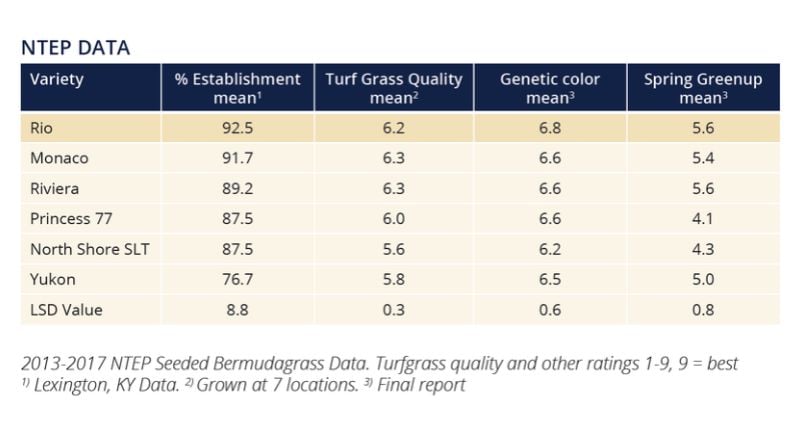
Rio has been evaluated through the National Turfgrass Evaluation Program (NTEP), which assesses turfgrass cultivars across different locations and growing conditions.
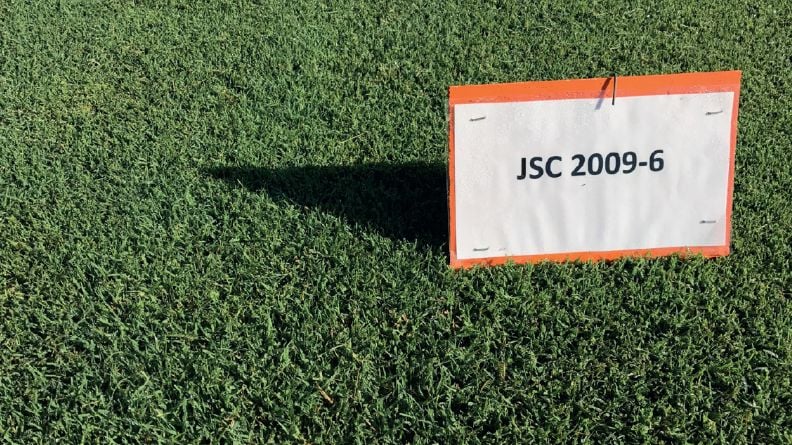
Rio Bermudagrass (JSC2009-6) growing in a turfgrass evaluation plot.
In the 2013–2017 NTEP Bermudagrass trials, Rio recorded strong establishment performance, alongside competitive ratings for turf quality, genetic color and spring green-up.
Cold tolerance and early spring green-up
Although Bermudagrass is adapted to warm climates, cultivars differ in their tolerance to colder temperatures and their ability to resume growth following winter dormancy.
Rio has demonstrated good cold and frost tolerance, making it suitable for warm-season and transitional growing regions.
Its early spring green-up is particularly valuable in Mediterranean climates, where winter temperatures can restrict Bermudagrass growth despite favorable conditions during much of the year.
Earlier green-up allows turf to resume active growth and recovery as temperatures increase, potentially extending the period during which the playing surface can regenerate.
The timing of dormancy and spring green-up will depend on local climate and seasonal temperatures.
Establishment and Smart Start seed treatment
Rio is recognized for its rapid germination and strong seedling vigor, making it suitable for new turf construction, renovation and conversion projects.
Rio is supplied with ICL’s Smart Start seed treatment, which helps retain moisture around the seed to support germination and early establishment.
Smart Start uses a biodegradable polymer coating that absorbs available soil moisture, creating a moisture-rich environment around the seed during the critical early stages of germination.
Successful establishment also depends on suitable soil temperatures, good seedbed preparation and consistent moisture.
Recommended establishment guidelines
- Soil temperature: Sow when soil temperatures are above 18 °C and rising.
- Sowing rate: 10–15 g/m².
- Sowing depth: Lightly cover the seed to a maximum depth of 3 mm.
- Germination: Germination can begin after approximately seven days under suitable conditions and may continue for up to 21 days.
- Irrigation: Maintain consistent moisture at the soil surface during germination and early seedling development.
- Mowing height: Established Rio can be maintained at 15–50 mm, depending on the application and management intensity.
Once established, Rio develops dense, fine-textured turf. More frequent mowing at lower heights within the recommended range can encourage a finer, denser playing surface when supported by appropriate nutrition and irrigation.
Rio in practice: Asolo Golf Club, Italy
The suitability of Rio for Mediterranean growing conditions is demonstrated at Asolo Golf Club in northern Italy, where the club is converting its courses from cool-season to warm-season turf.
Following a successful trial in 2025, the club began converting its first course to ProSelect Rio in June 2026.

ProSelect Rio Bermudagrass established on the fairways at Asolo Golf Club, Italy.
Despite summer temperatures reaching 30–35 °C, Rio established successfully, achieving approximately 90% turf coverage by October.
The conversion forms part of a wider project to establish warm-season turf across all 27 holes, helping the club address the challenges of summer drought, disease pressure and increasing maintenance costs.
Establishing Rio from seed also provided an alternative to the considerably higher costs associated with vegetative Bermudagrass establishment.
Read the full case study at Asolo Golf Club.
Where can Rio be used?
Rio is particularly suited to professional turf applications in warm-season and transitional climates where turf density, wear recovery and summer performance are priorities.
Typical applications include:
- Golf fairways and tees
- Professional sports pitches
- Sports training grounds
- Football and rugby pitches
- Sports turf construction and renovation
- Warm-season turf conversion projects
- Lawns and ornamental turf
- Sod production
Rio can be established directly from seed, providing an alternative to vegetative Bermudagrass establishment methods such as sprigging or sodding.
Its combination of establishment performance, turf quality and cold tolerance makes it particularly relevant for professional turf managers considering warm-season grasses for sports and golf applications.
Rio in the ProSelect range
Rio is available within our ProSelect range. Availability varies by market, so please check your local ProSelect range for details.