


 Whatsapp
  X
X  Mail
Mail  Copy link
 Traction: Kentucky bluegrass cultivar profile

On this page:
Traction is a European-bred Kentucky bluegrass (Poa pratensis), also known as smooth-stalked meadow-grass, selected for its wear tolerance, recovery and dense rhizomatous growth.
Particularly suited to heavily used sports surfaces, Traction combines high shoot density, fine leaf texture and good summer drought tolerance. Its relatively quick establishment compared with many other Kentucky bluegrass cultivars makes it a useful choice for sports turf establishment and renovation, particularly where durability and recovery are priorities.
Traction at a glance
| Species | Kentucky bluegrass (Poa pratensis) |
| Alternative species name | Smooth-stalked meadow-grass |
| A-LIST cultivar | No |
| Breeding | European genetics |
| Growth habit | Rhizomatous |
| Leaf texture | Fine |
| Color | Medium green |
| Key strengths | Wear tolerance and recovery |
| Additional characteristic | High shoot density, summer drought tolerance and surface stability |
| Typical uses | Sports pitches, stadiums, training grounds and sod production |
| Sowing rate | 20 g/m² |
| Recommended mowing height | 15 – 25 mm |
Tractions recommended sowing rate is 20 g/m², with a mowing height of 15–25 mm.
What are the characteristics of Traction?
Traction combines the dense, rhizomatous growth habit of Kentucky bluegrass with characteristics particularly valuable for intensively managed sports turf.
Its high shoot density and fine leaf texture help produce a uniform playing surface, while its underground rhizomes allow the grass to spread laterally and contribute to turf recovery following wear.
Traction also offers good summer drought tolerance and a medium-green appearance, making it compatible with perennial ryegrass and other grasses commonly used in sports turf mixtures.
An additional characteristic is its relatively quick establishment compared with many other Kentucky bluegrass cultivars, which typically establish more slowly than perennial ryegrass.
Why is Traction suited to high-wear sports turf?
Wear tolerance and recovery are among Traction’s most important characteristics.
Sports pitches are exposed to repeated traffic, particularly in high-use areas such as goalmouths, training zones and frequently used playing surfaces.
Traction’s combination of high shoot density, rhizomatous growth and recovery characteristics helps maintain turf coverage under these demanding conditions.
Its dense growth also contributes to surface stability, an important consideration for sports turf where consistent footing and playing quality are priorities.
These characteristics make Traction particularly relevant for professional stadium pitches, sports training grounds and intensively used natural grass playing surfaces.
Traction performance
Traction has been evaluated in STRI trials assessing characteristics relevant to sports turf performance, including ground cover, visual merit, recovery, shoot density and leaf fineness.
The 2022 STRI data highlights Traction’s performance across these characteristics, with particularly strong results for recovery, shoot density and visual merit.
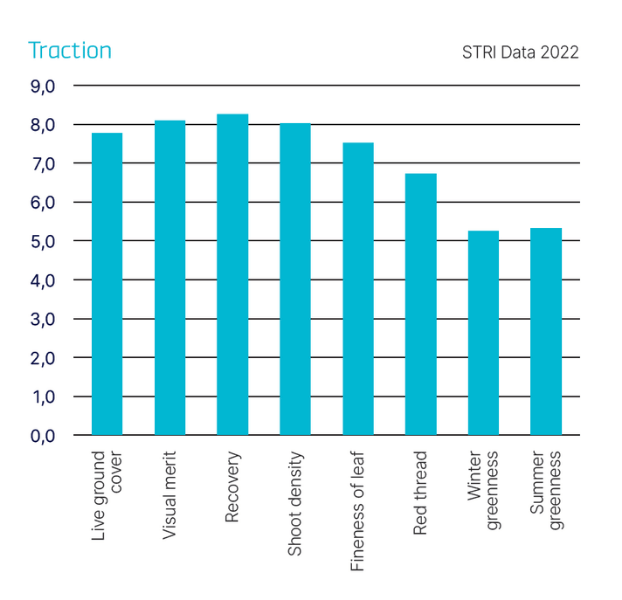
These results demonstrate Traction’s strengths in characteristics important for maintaining turf density, recovery and consistent playing surface quality.
How does rhizomatous growth support turf recovery?
One of the defining characteristics of Kentucky bluegrass is its ability to produce rhizomes.
Rhizomes are underground stems that allow the grass to spread laterally, producing new shoots and helping turf recover from wear and damage.
This differs from the predominantly bunch-type growth habit of conventional perennial ryegrass.
For sports turf managers, rhizomatous growth offers several advantages:
- Helps maintain ground cover following wear
- Supports lateral recovery into damaged areas
- Contributes to dense, stable playing surfaces
- Helps maintain turf continuity during the growing season
Traction combines this growth habit with strong wear tolerance and recovery characteristics.
When used in mixtures with perennial ryegrass, Traction contributes density and recovery potential, complementing the generally faster establishment of perennial ryegrass.
Establishment and turf quality
Traction establishes more quickly than many other Kentucky bluegrass cultivars, making it suitable for both new sports turf establishment and renovation programs.
Once established, it produces dense turf with a fine leaf texture and medium-green appearance.
Its high shoot density contributes to a consistent playing surface, while rhizomatous growth supports continued turf development and recovery.
Traction also offers good summer drought tolerance, an important characteristic for sports surfaces exposed to periods of limited moisture availability.
As with other Kentucky bluegrass cultivars, successful establishment depends on suitable soil temperatures, adequate moisture and appropriate management during early growth.
Where can Traction be used?
Traction is particularly suited to intensively managed sports turf where wear tolerance, recovery and surface stability are important.
Typical applications include:
- Professional stadium pitches
- Sports training grounds
- Football and rugby pitches
- High-wear natural grass sports surfaces
- Sports turf renovation and establishment
- Sod production
Traction can be sown as a straight cultivar or incorporated into mixtures with perennial ryegrass.
Its combination of rhizomatous growth, high density and wear recovery makes it particularly valuable where maintaining consistent ground cover and playing surface quality is a priority.
Traction in the ProSelect range
Traction is used in selected ProSelect grass seed blends. Product availability and blend compositions vary by country, so please check your local ProSelect range for details.


