Whatsapp
  X
X  Mail
Mail  Copy link
 Bentgrasses: Characteristics, Uses and Performance

On this page:
What are bentgrasses?
Bentgrasses (Agrostis spp.) are fine-leaved cool-season grasses widely used in closely mown professional turf, particularly golf greens and other fine turf surfaces.
Their ability to form dense turf and tolerate very low mowing heights makes them particularly important for putting surfaces. Different bentgrass species have distinct growth habits and management characteristics, so species and cultivar choice can have a significant influence on the type of surface produced and how it needs to be managed.
In professional turf, two of the most important species are creeping bentgrass (Agrostis stolonifera) and browntop bentgrass (Agrostis capillaris).
Where do bentgrasses perform best?
Bentgrasses are most strongly associated with golf greens, where their fine leaves, density and tolerance of close mowing enable them to produce high-quality putting surfaces.
Depending on the species and cultivar, bentgrasses can also be used on golf tees, fairways and other closely mown fine turf.
The choice between species should take account of the required surface, climate, management regime and the characteristics of the existing turf. Creeping and browntop bentgrasses can both be used on golf greens, but their different growth habits mean they do not behave or need to be managed in exactly the same way.
| Characteristic | Creeping bentgrass | Browntop / colonial bentgrass |
|---|---|---|
| Latin name | Agrostis stolonifera | Agrostis capillaris |
| Growth habit | Stoloniferous | Short rhizomes and tillering |
| Close mowing | Excellent | Very good |
| Turf character | Dense, uniform turf | Fine, dense turf |
| Typical golf use | Primarily putting greens; also other closely mown areas | Greens, tees and other fine turf |
| Key distinction | Strong lateral growth and recovery through stolons | Fine-leaved species suited to lower-input fine turf situations |
The distinction matters because growth habit affects how the turf develops and responds to management. Species selection should therefore be based on the surface being managed and the performance required rather than treating all bentgrasses as interchangeable.
Creeping bentgrass
Creeping bentgrass (Agrostis stolonifera) is characterised by its strong stoloniferous growth habit. Mature plants typically have bluish-green, visibly ribbed leaves that are relatively broad in proportion to their length, while a prominent blunt ligule is another useful identification characteristic.
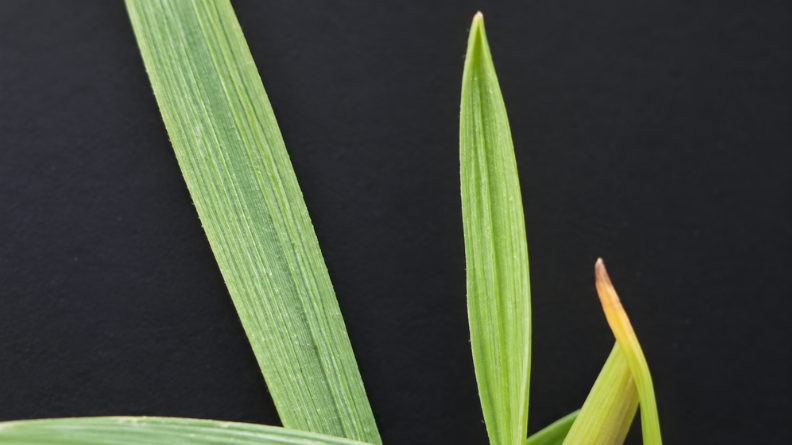
Creeping bentgrass (Agrostis stolonifera) showing its characteristic ribbed, bluish-green leaves. Based on an original photograph, with AI used to improve image quality and presentation for illustrative purposes only.
Stoloniferous growth
The defining characteristic of creeping bentgrass is the way it spreads. Stolons grow horizontally across the soil surface and can produce new roots and shoots at the nodes. This allows the plant to spread laterally and develop new growth away from the parent plant.
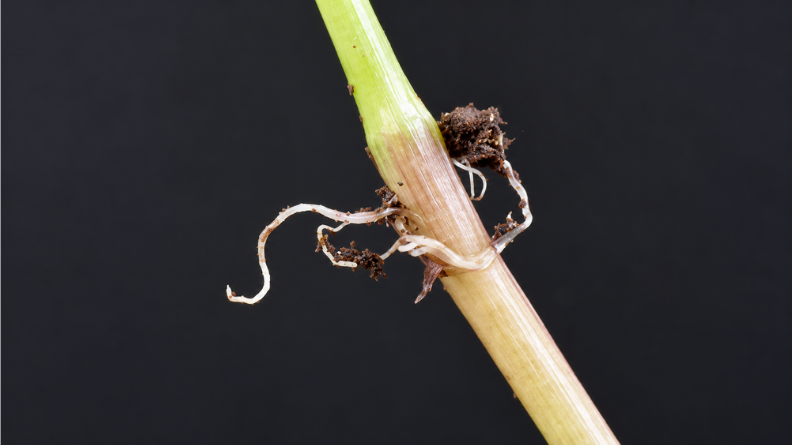
Creeping bentgrass (Agrostis stolonifera) stolon showing new root and shoot development at a node. Based on an original photograph, with AI used to improve image quality and presentation for illustrative purposes only.
Creeping bentgrass also develops a strong, dense root system. Together with its stoloniferous growth, this contributes to its ability to establish and compete within closely managed turf.
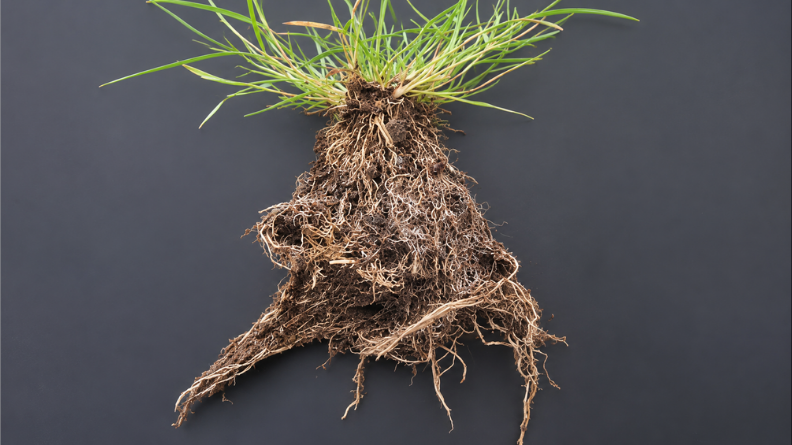
Dense root development of creeping bentgrass (Agrostis stolonifera). Based on an original photograph, with AI used to improve image quality and presentation for illustrative purposes only.
Identifying creeping bentgrass
A prominent blunt ligule is one of the useful botanical characteristics for identifying creeping bentgrass. However, individual identification features can be difficult to see in closely mown turf.
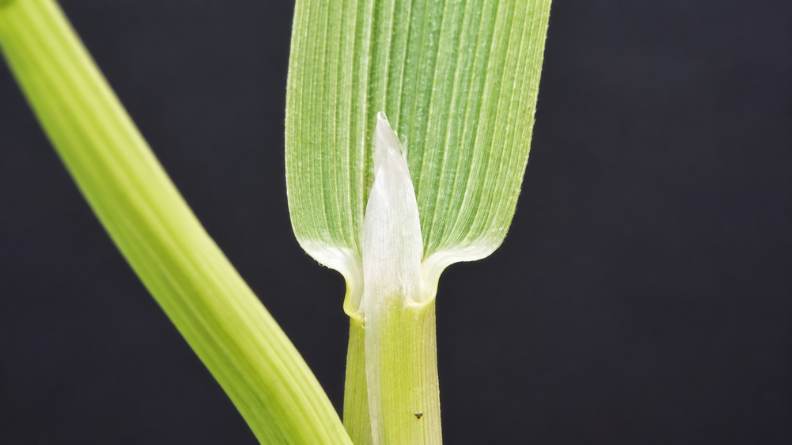
The prominent blunt ligule is a useful identification characteristic of creeping bentgrass (Agrostis stolonifera). Based on an original photograph, with AI used to improve image quality and presentation for illustrative purposes only.
The appearance of a mature individual plant can be very different from creeping bentgrass maintained on a golf green. At putting-green mowing heights of around 2–3 mm, many leaf and growth characteristics become much less obvious and may require magnification to identify.
This is important when comparing botanical specimens with the dense, uniform surface produced by creeping bentgrass under intensive golf-green management.
Why is creeping bentgrass used on golf greens?
Its combination of tolerance to very close mowing, density and lateral growth makes creeping bentgrass particularly suited to golf putting greens.
The stoloniferous growth habit also means that plants can spread into surrounding areas rather than relying solely on the production of new shoots from an individual crown.
Creeping bentgrass can also be used on tees and fairways where its characteristics suit the climate and management regime.
Browntop bentgrass
Browntop bentgrass (Agrostis capillaris), also known as colonial bentgrass in some markets, is another fine-leaved cool-season bentgrass widely associated with golf greens and fine turf.
Unlike the strongly stoloniferous growth of creeping bentgrass, browntop has a more tufted growth habit and does not produce the same surface-spreading stolons. This gives it a distinctly different growth character while still allowing it to form a fine, dense turf.
Browntop can also be distinguished botanically by its relatively inconspicuous ligule, although, as with other bentgrasses, identification features can be difficult to see in closely mown turf and may require magnification.
Modern browntop bentgrass cultivars can combine close-mowing tolerance with characteristics such as shoot density, visual quality, winter performance and disease tolerance. Browntop can be used alone or as part of mixtures with fine fescues and other bentgrasses, depending on the turf environment and management objective.
How do bentgrasses perform under stress?
Close mowing
Close-mowing tolerance is one of the defining characteristics of bentgrasses used for professional turf.
Both creeping and browntop bentgrass can be maintained at the low mowing heights required for golf greens, although performance depends on cultivar, growing conditions and the wider management programme.
Wear and recovery
Growth habit influences the way bentgrasses respond to turf damage.
The stolons of creeping bentgrass allow plants to spread laterally into surrounding areas, contributing to surface density and recovery. Browntop bentgrass does not have the same aggressive stoloniferous growth habit, so its response and management requirements differ.
Disease
Disease susceptibility varies between bentgrass species and, importantly, between individual cultivars.
Modern breeding programmes select for characteristics including resistance or tolerance to important turf diseases. Disease performance should therefore be considered at cultivar level rather than assuming all bentgrasses will respond in the same way.
Environmental stress
Temperature, moisture availability, soil conditions and management intensity can all influence bentgrass performance.
Cultivars have been developed for different climatic and management conditions, making cultivar selection particularly important where turf is exposed to heat, cold, drought or other environmental stresses.
Modern bentgrass cultivars
Bentgrass species describe the broad characteristics of the plant, but there can be considerable variation between cultivars within the same species.
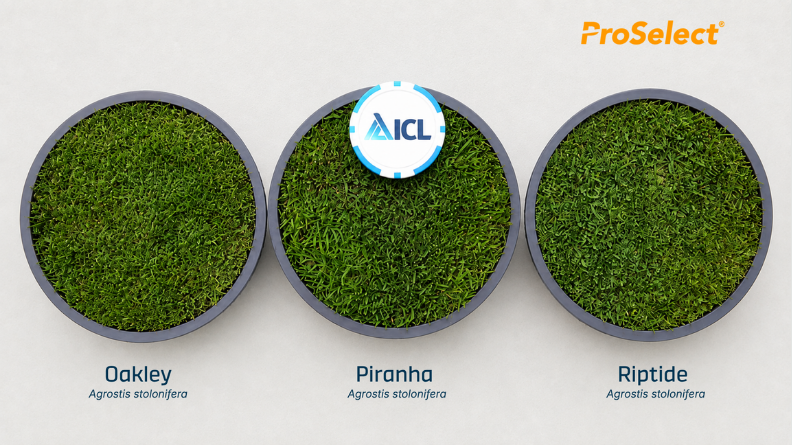
Oakley, Piranha and Riptide creeping bentgrass (Agrostis stolonifera) cultivars, illustrating variation between cultivars within the same species. Based on an original photograph, with AI used to improve image quality and presentation for illustrative purposes only.
Modern breeding has developed bentgrass cultivars with differences in characteristics such as:
- shoot density
- establishment
- growth habit
- colour
- disease tolerance
- drought and temperature tolerance
- seasonal performance
- turf quality
This means that choosing between creeping and browntop bentgrass is only the first decision. Cultivar selection can further refine the characteristics of the turf for a particular climate, surface and management objective.
ICL bentgrass cultivars
ICL’s ProSelect portfolio includes creeping and browntop bentgrass cultivars selected for different golf turf environments and performance requirements.
Creeping bentgrass – Agrostis stolonifera
MTV-1 Oakley
A creeping bentgrass cultivar selected for use on closely mown golf turf. Find out more.
Riptide
A fine-leaved creeping bentgrass suited to greens, tees and fairways, with an upright, low-growing habit and high tiller density. Riptide has been selected for characteristics including establishment, seasonal performance and disease tolerance. Find out more.
Piranha
A creeping bentgrass selected for performance under a range of turf stresses, including heat and cold, together with disease tolerance and early spring green-up. Find out more.
Memorial
A creeping bentgrass developed for closely mown turf, with disease tolerance among its selected characteristics. Find out more.
Browntop bentgrass – Agrostis capillaris
Heritage
A browntop bentgrass selected for golf and bowling greens, with characteristics including shoot density, winter performance and Microdochium patch tolerance. Find out more.