Whatsapp
  X
X  Mail
Mail  Copy link
 Diploid vs Tetraploid Perennial Ryegrass: What Is the Difference?
Understand the practical differences between diploid and tetraploid perennial ryegrasses and what they mean for sports turf performance.

On this page:
Perennial ryegrass (Lolium perenne) is widely used for sports turf because it establishes quickly, tolerates wear and can recover following intensive use.
One important distinction between cultivars is ploidy. Diploid perennial ryegrass has two sets of chromosomes, while tetraploid perennial ryegrass has four. This genetic difference influences seed size, leaf width, tillering, sward density and overall turf performance.
For turf managers, the important question is not the chromosome count itself, but what those differences mean for the finished playing surface.
What are diploid and tetraploid perennial ryegrasses?
Diploid perennial ryegrass has two sets of chromosomes, while tetraploid ryegrass has four.
In practical terms, tetraploid cultivars typically produce larger seeds and broader leaves, while diploids generally produce finer leaves and more shoots or tillers.
Diploids therefore tend to form a tighter, denser canopy, while tetraploids generally produce fewer shoots and a more open sward.
Individual cultivar performance still matters, so ploidy should not be used as the only selection criterion.
Seed size and establishment
Tetraploid perennial ryegrass generally has larger seed, which can support vigorous early seedling growth.
However, larger seed also means fewer seeds per unit weight. Tetraploid perennial ryegrasses can contain up to 50% fewer seeds per kilogram than diploid turf perennial ryegrasses.
The same weight of seed therefore does not necessarily provide the same number of potential plants.
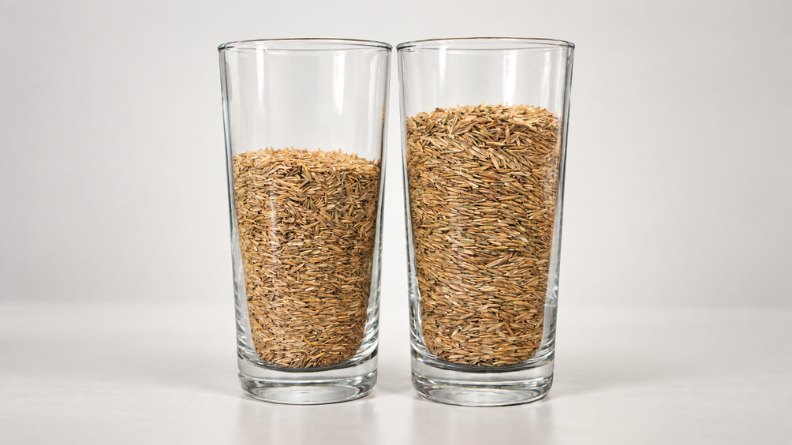
Diploid seed (left) and tetraploid seed (right). Photograph enhanced using AI for presentation purposes; scientific content unchanged.
For sports turf, successful establishment is not simply about producing visible growth quickly. The objective is to establish enough plants to develop a dense, durable surface.
Cultivar performance is therefore important alongside seed size.
GreenPlanet, is a diploid perennial ryegrass cultivar with rapid establishment and lower-temperature germination, while Stellar 4GL is a diploid cultivar with high seedling vigour.
ProSelect Speed Germ-ZT combines diploid perennial ryegrass cultivars selected for establishment under sub-optimal and lower-temperature conditions, with ZipSeed treatment to support germination and early establishment.
The practical point is that larger seed should not automatically be interpreted as better establishment. Seed type, cultivar choice and seedbed preparation all influence the result.
Sward density and wear
For sports turf, one of the most important differences between diploids and tetraploids is what happens after establishment.
Diploid cultivars generally produce more tillers and finer leaves, helping create a dense, tightly knit canopy.
That density helps maintain live ground cover and surface uniformity under repeated traffic. Independent trials have associated diploid cultivars with greater shoot density and improved surface stability under intensive use.
The ICL diploid portfolio includes individual perennial ryegrass cultivars selected for different performance characteristics.
Torsion TRT, Stellar 4GL, Slugger 3GL and Fastball 3GL bring strong summer wear performance, while Grandslam GLD, combines good summer recovery with heat and drought tolerance.
ProSelect Premium Pitch combines diploid perennial ryegrass cultivars selected for characteristics including shoot density, wear tolerance and fine appearance, making it suited to intensively managed sports turf.
Where tetraploids can add value
Tetraploid perennial ryegrasses can still provide useful characteristics.
The UK BSPB/STRI comparison found that leading tetraploid cultivars performed strongly for Red Thread resistance and seasonal greenness, while leading diploids performed better for live ground cover, recovery, leaf fineness and visual merit.
Tetraploids may therefore have a role where particular disease, color or establishment characteristics are priorities.
For intensively managed sports turf, however, where density, wear performance and a fine, uniform canopy are critical, the typical characteristics of diploid ryegrass are particularly valuable.
Disease and stress performance should still be considered at cultivar level rather than assumed from ploidy alone.
Selecting perennial ryegrass for sports turf
Choosing between diploid and tetraploid perennial ryegrass should start with the performance requirements of the surface.
For intensively managed sports turf, priorities may include live ground cover, shoot density, wear tolerance, fine leaf texture, establishment and disease tolerance.
Ploidy can help indicate the general characteristics of a cultivar, but it should not be used as the sole selection criterion.
The final choice should be based on individual cultivar performance and how complementary cultivars are combined within a seed mixture.
For high-use sports surfaces, this means selecting mixtures that deliver the required balance of establishment, density, recovery, wear tolerance and resilience rather than choosing on chromosome number alone.