Whatsapp
  X
X  Mail
Mail  Copy link
 Nitrogen in Turf Management
Understanding how nitrogen influences turf growth, nutrient demand and performance, and how to use it more efficiently within a turf management program.

On this page:
Nitrogen is the most important nutrient in turf management.
It has a greater influence on turf growth, color and plant development than any other nutrient. It also affects the turf’s demand for phosphorus, potassium, calcium, magnesium and other elements.
For that reason, nitrogen should be the starting point for a turf nutrition program.
However, applying nitrogen is not simply a question of adding more fertilizer to produce greener turf. The amount applied, the form in which it is supplied, the timing of the application and the way it is delivered all influence the response.
Too little nitrogen can limit turf growth, recovery and presentation. Too much can create excessive leaf growth, reduce rooting, increase maintenance requirements and raise the risk of nutrient losses.
This article explains ICL’s approach to nitrogen in turf management: start with the growth response required, supply nitrogen in a form that supports that objective and use it as efficiently as possible.
What is nitrogen?
Nitrogen (N) is an essential macronutrient required in greater quantities than most other mineral nutrients.
It typically makes up around 2% to 6% of the dry matter within a grass plant, placing it behind only carbon, hydrogen and oxygen in terms of plant composition.

Typical mineral composition of turfgrass plant dry matter, showing potassium as a major macronutrient alongside nitrogen, phosphorus, calcium, magnesium and sulphur.
This reflects the central role nitrogen plays in turf growth and plant function.
Nitrogen is present in every amino acid. Amino acids are the building blocks used by the plant to produce proteins, enzymes, chlorophyll, hormones and many of the other compounds required for growth and development.
Without an adequate nitrogen supply, turf cannot produce enough of these compounds to maintain healthy growth.
Unlike nitrogen-fixing legumes, turfgrass cannot make meaningful use of the nitrogen gas that makes up most of the atmosphere. It depends instead on nitrogen released from the rootzone or supplied through fertilizer applications.
On intensively managed turf, grass clippings may also be removed regularly. This removes nitrogen that has been taken up by the plant and increases the need for planned fertilizer inputs.
What does nitrogen do?
Nitrogen has a direct influence on many of the characteristics turf managers see and manage every day.
It supports:
- Leaf and shoot growth.
- Turf color and density.
- Recovery from wear and maintenance.
- The production of proteins, enzymes and chlorophyll.
- The development of new plant tissue.
- The turf’s demand for other essential nutrients.
When nitrogen availability increases, turf generally produces more growth and develops a stronger green color.
This response is one of the reasons nitrogen is such an effective management tool. It can be used to encourage recovery, improve density, support establishment or maintain a surface through periods of play and maintenance.
However, the growth response must be appropriate for the surface.
A heavily used sports pitch may require enough nitrogen to sustain recovery from wear. A fine turf surface may require a lower, more consistent input to maintain quality without creating excessive clipping production or reducing surface refinement.
The objective is not to maximize growth. It is to produce the amount and type of growth required by the surface.
How important is nitrogen to turf growth?
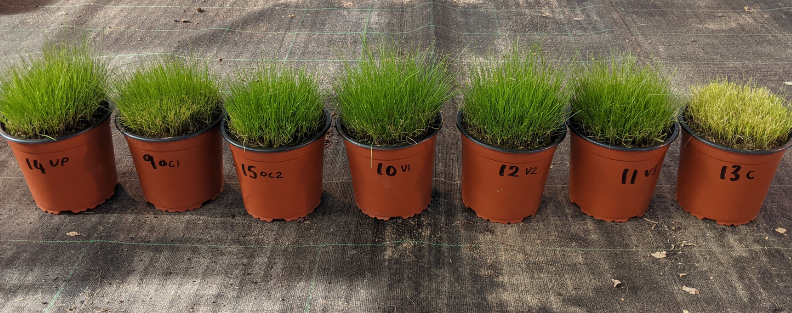
The importance of nitrogen can be seen clearly in an ICL nutrient-omission demonstration.
Perennial ryegrass was grown in an inert medium and supplied with a controlled nutrient solution, with one nutrient deliberately withheld from each treatment, as identified on the pots.
The image shows the treatments after 21 days of nutrient omission.
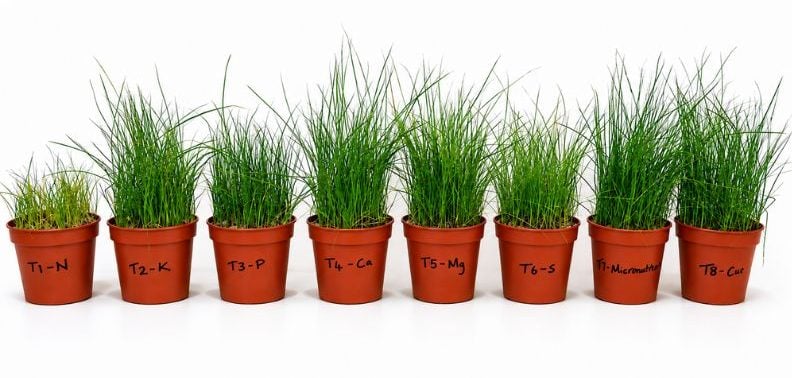
ICL nutrient-omission demonstration with perennial ryegrass after 21 days of nutrient omission. Each treatment received a complete nutrient solution with one labelled nutrient withheld. The nitrogen-deficient treatment shows pronounced yellowing and restricted growth.
While several omissions affected plant development, the treatment without nitrogen showed the clearest reduction in growth and green color.
This demonstrates nitrogen’s central role in chlorophyll production, protein formation and the development of new turf growth.
Why does nitrogen lead the nutrition program?
ICL’s approach to turf nutrition is based on the principle of nitrogen-led nutrient demand.
Turf nutrient uptake is closely linked to plant growth. As the turf grows more quickly, it requires more phosphorus, potassium, calcium, magnesium and other nutrients to support the production of new plant tissue.
Nitrogen is one of the main nutrients controlling that growth rate.
This means the turf’s demand for many other nutrients is largely driven by the nitrogen supplied and the growth that follows.
The starting point for a fertilizer program should therefore be:
- How much growth is required?
- How much nitrogen is needed to support that growth?
- What amounts of the other nutrients are then required alongside it?
This is a more useful approach than applying individual nutrients simply because a soil analysis shows that one level is lower than another.
Once the rootzone contains enough of a nutrient to prevent deficiency, the turf will not necessarily continue absorbing more simply because more is present. Nutrient applications should be related to plant demand, not just to the total quantity measured in the soil.
This does not make soil analysis irrelevant. Soil testing remains valuable for understanding pH, rootzone characteristics and potential nutrient limitations.
However, soil results should be interpreted alongside turf growth, species, surface use, environmental conditions and the nitrogen program rather than being used as a fertilizer prescription on their own.
How much nitrogen does turf need?
There is no single nitrogen rate that is suitable for every turf surface.
The amount required depends on several connected factors, including:
- Grass species.
- Surface type and required quality.
- Intensity of play and wear.
- Mowing height and clipping removal.
- Rootzone construction.
- Temperature, moisture and light.
- Existing turf condition.
- Maintenance operations such as renovation, overseeding and topdressing.
- The amount of growth the turf manager wants to produce.
A golf green, stadium pitch, training ground, lawn and landscape area may all respond to the same nitrogen sources, but they do not require the same program.
Nitrogen recommendations must therefore be site-specific.
One way of improving nitrogen planning is to consider growth potential. Growth potential uses temperature data to estimate how actively cool-season or warm-season turf is capable of growing at different times of the year.
This provides a useful starting point for adjusting nitrogen inputs through the season.
When growth potential is low, the turf’s ability to use nitrogen is also limited. When conditions support stronger growth, higher inputs may be justified if that growth is required.
Growth potential is not a complete recommendation by itself. Moisture, light, turf condition and management objectives must still be considered. However, it helps move nitrogen planning away from fixed calendar applications and towards the likely requirements of the plant.
Clipping yield can also provide useful information, particularly on golf greens. Monitoring the volume of clippings removed allows turf managers to see whether growth is increasing, decreasing or becoming inconsistent across different surfaces.

Clipping collection provide a practical indication of turf growth and can help inform nitrogen planning.
Nitrogen inputs can then be adjusted according to the measured response rather than appearance alone.
Why is more nitrogen not always better?
Nitrogen produces growth, but excessive growth is not the same as improved turf performance.
When nitrogen uptake increases, the plant also requires more carbon to convert that nitrogen into amino acids and new plant material. That carbon must come from photosynthesis.
If large amounts of nitrogen are supplied when photosynthetic activity is restricted, the plant may direct more resources towards leaf growth and less towards roots, cell walls and other structural material.
This can result in:
- Excessive clipping production.
- Softer leaf growth.
- Reduced root development.
- Increased mowing requirements.
- Lower wear tolerance.
- Greater susceptibility to some pests or diseases.
- Less refined playing surfaces.
- More nitrogen being exposed to potential loss.
The risk is particularly important during periods of low light, low temperature, drought stress or other conditions that limit photosynthesis and plant growth.
Applying nitrogen during these periods does not automatically produce a useful response.
The right question is not, “How much nitrogen can be applied?” It is, “How much nitrogen can the turf use to produce the response required under the current conditions?”
Efficient nitrogen management means meeting turf demand without repeatedly pushing growth beyond the needs of the surface.
Does the form of nitrogen matter?
The amount of nitrogen applied is important, but it does not fully determine the turf response.
The form of nitrogen also affects how quickly it becomes available, how long the response lasts and how exposed it is to potential losses.
Common fertilizer nitrogen sources include:
- Nitrate.
- Ammonium.
- Urea.
- Slowly available nitrogen sources such as methylene urea.
- Organic nitrogen.
- Inhibited nitrogen.
- Polymer-coated controlled-release nitrogen.
Highly soluble mineral nitrogen forms can provide a rapid response because they become available quickly. This can be useful where an immediate turf response is required, but it can also increase the risk of flush growth or nutrient loss if the rate, timing or conditions are unsuitable.
Organic nitrogen must generally be broken down by soil microorganisms before most of the nitrogen becomes available to the turf. Its release is therefore influenced by temperature, moisture, pH and microbial activity.
Slow-release and controlled-release fertilizers supply nitrogen over a longer period.
Methylene urea releases nitrogen gradually through a combination of solubility and microbial activity. Polymer-coated fertilizers release nutrients through the coating over a defined period, helping to provide a more controlled supply.
For a closer look at how the different nitrogen sources work and when to use them, read our guide to the different forms of nitrogen in turf management.
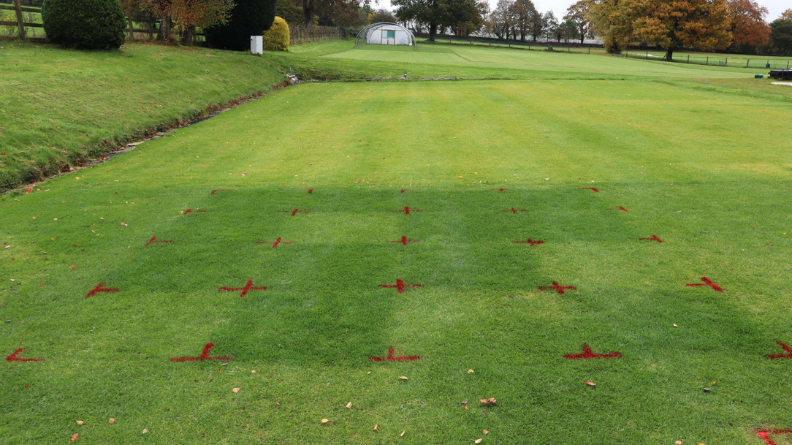
Fertilizer trial plots at STRI, Bingley, comparing turf response to different nitrogen technologies applied at the same nitrogen rate.
eqo.s is ICL’s biodegradable coating technology for controlled-release fertilizer.
In a 14-week trial conducted independently by STRI, an eqo.s coated fertilizer provided significantly better turf colour, quality and NDVI from day 28 through to day 84 than slow-release and inhibited nitrogen treatments applied at the same nitrogen rate.
These technologies can help turf managers avoid sudden growth peaks, extend the response from an application and improve nitrogen-use efficiency.
The most effective turf fertilizer programs will often combine different nitrogen forms rather than depend on a single source.
A product may contain immediately available nitrogen to initiate a response alongside slow-release or controlled-release nitrogen to sustain it. A seasonal program may also use different technologies at different times according to the required turf response and environmental conditions.
The correct nitrogen form is therefore determined by the role the fertilizer needs to perform.
How should nitrogen be supplied?
Nitrogen can be supplied through granular or liquid fertilizer applications.
Neither method is automatically better. The right choice depends on the surface, the equipment available, the required response and the way the turf manager wants the nitrogen to be taken up.
Granular fertilizers are generally applied to the turf surface and watered into the rootzone. They are particularly useful where a longer-lasting response is required or where slow-release and controlled-release technologies form part of the program.
Liquid fertilizers like Greenmaster Liquid Advance provide flexibility for applying smaller amounts of nitrogen more frequently.
Depending on the formulation, application rate, water volume and conditions, nitrogen may be absorbed through the leaf or delivered into the rootzone.
Foliar applications can be efficient on closely mown turf because the dense leaf canopy intercepts much of the spray before it reaches the soil.
However, successful foliar feeding depends on suitable application conditions.
Uptake is generally improved when applications are made in cooler conditions, the spray is distributed evenly and the leaf remains uncut and free from rainfall or irrigation for enough time to allow absorption.
Applications made in hot conditions may be less effective because the stomata on the leaf can close, limiting one of the routes through which nutrients enter the plant.
Granular and liquid nutrition should therefore be viewed as complementary tools.
The decision should consider:
- The required speed and duration of response.
- The nitrogen form being applied.
- Irrigation availability.
- Weather conditions.
- Application equipment.
- Surface area.
- Labor and operational requirements.
- Whether the objective is foliar or root uptake.
How can nitrogen losses be reduced?
Nitrogen is essential, but it is also one of the nutrients most vulnerable to loss.
ICL’s position is that every nitrogen recommendation should consider both the turf response and nitrogen-use efficiency: how much of the applied nutrient is taken up and used by the plant rather than lost from the system.
The main potential losses are leaching, volatilization and denitrification.
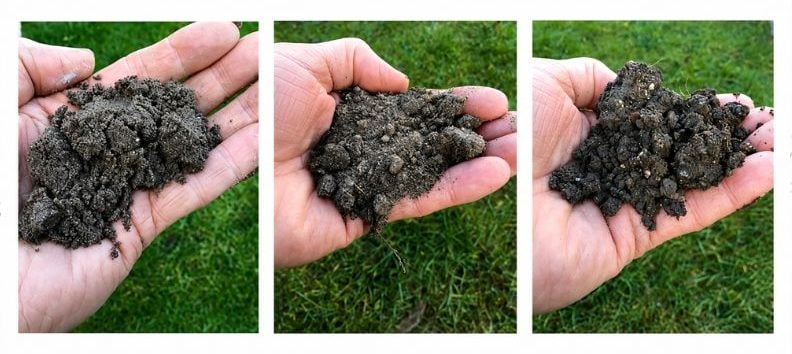
Different soil structures influence how water and nutrients move through the rootzone, affecting nitrogen retention and the risk of loss.
Leaching
Nitrate is highly soluble and can move down through the rootzone with water.
The risk is greatest on sandy rootzones, during heavy rainfall or excessive irrigation, and where easily available nitrogen has been applied at a rate greater than the turf can use.
Leaching risk can be reduced by:
- Matching nitrogen inputs to turf demand.
- Avoiding fertilizer applications during excessively wet conditions.
- Improving irrigation uniformity and avoiding overwatering.
- Using lower application rates where appropriate.
- Selecting suitable fertilizers during turf establishment, when bare or immature rootzones are particularly vulnerable to loss.
- Using slow-release or controlled-release nitrogen.
In a matched-nitrogen trial at Reaseheath College, a single application of eqo.s controlled-release fertilizer significantly reduced nitrate-N leaching compared with conventional, slow-release and inhibited fertilisers, while maintaining more consistent turf color and growth.
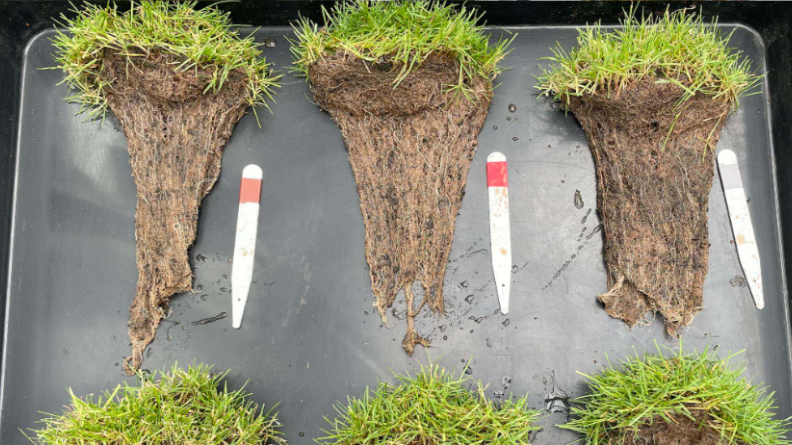
Turf samples prepared for assessment of root development during the Reaseheath fertilizer trial.
Applying more nitrogen does not compensate for poor irrigation management. Where water moves unevenly or excessively through the rootzone, nitrogen-use efficiency will also be reduced.
Volatilization
Urea can be converted into ammonia gas and lost to the atmosphere if it remains on the turf or soil surface.
The risk increases in dry conditions, where irrigation or rainfall is not available to move urea into the rootzone, and on high-pH surfaces.
Fertilizers containing free urea should normally be watered in where the objective is root uptake.
Where irrigation is unavailable, or conditions are particularly dry, slow-release or coated nitrogen may provide a more appropriate option.
A Bangor University glasshouse trial found that eqo.s coated fertilizer reduced ammonia volatilization by 58% compared with uncoated urea, demonstrating how controlled nutrient release can improve nitrogen-use efficiency.
Turfgrass pots used in the Bangor University glasshouse study investigating nitrogen losses from coated and uncoated urea fertilizers.
Denitrification
Denitrification occurs when nitrate is present in waterlogged or oxygen-deficient rootzones.
Under anaerobic conditions, soil microorganisms use oxygen from nitrate compounds, converting the nitrogen into gases that can escape from the system.
The risk can be reduced by:
- Avoiding nitrogen applications to saturated or waterlogged surfaces.
- Improving drainage and aeration.
- Managing excessive thatch.
- Avoiding unnecessary winter applications where plant demand is low.
- Using nitrogen sources and application rates that better match the conditions.
Nitrogen efficiency is not achieved through one product or technology alone.
It comes from matching the rate, nitrogen form, application method, irrigation and timing to the turf’s ability to use the nutrient.
Understanding nitrogen in context
Nitrogen should sit at the center of every turf nutrition program.
It drives growth, influences turf color and recovery, and determines much of the plant’s demand for other nutrients.
That importance also means nitrogen must be managed carefully.
The objective is not simply to apply enough nitrogen to make the turf grow. It is to produce controlled, appropriate growth that supports the performance, presentation and resilience required from the surface.
That requires turf managers to consider:
- The growth response they want.
- The amount of nitrogen needed to produce it.
- The form of nitrogen best suited to the situation.
- How and when the fertilizer should be applied.
- How environmental conditions affect uptake.
- How potential nitrogen losses can be minimized.
Nitrogen works best when it is planned as part of a complete program rather than treated as an isolated application.
By matching nitrogen inputs to plant demand and selecting technologies that deliver the required release pattern, turf managers can maintain performance while reducing unnecessary growth, avoiding waste and making more efficient use of every application.