Whatsapp
  X
X  Mail
Mail  Copy link
 Sports fields renovation: Seeding or sodding?

On this page:
Sports field renovation: when overseeding is not enough
Where sports fields have experienced sustained wear and adverse weather, overseeding alone is often too slow to deliver a playable surface before the next season. In these situations, re-turfing is not a preference but a necessity driven by time, risk, and surface stability.
The decision should be made early, based on recovery timelines and the condition of the existing root system.

ICL Turf Grass trial assessment plot – The Netherlands
When overseeding works, and when it doesn’t
Overseeding is effective where there is still functional turf cover and an established root mass. It becomes unreliable once density has collapsed, soil is exposed, or Poa annua has become dominant. Under those conditions, new seedlings struggle to establish quickly enough to restore surface integrity.
Re-turfing provides immediate cover, but success depends on rapid root migration into the underlying profile. That establishment phase determines whether the surface will tolerate early use.

100% Poa pratensis sod, starting to root in less than one week
Species choice determines recovery speed
Perennial ryegrass remains the fastest-establishing option and is well suited to tight renovation windows. Hybrid Poa pratensis varieties can contribute longer-term stability and shear strength, provided rooting conditions are optimized.
For sod renovation, species selection should prioritize rapid rooting potential, structural strength within the turf layer, and compatibility with the existing rootzone.
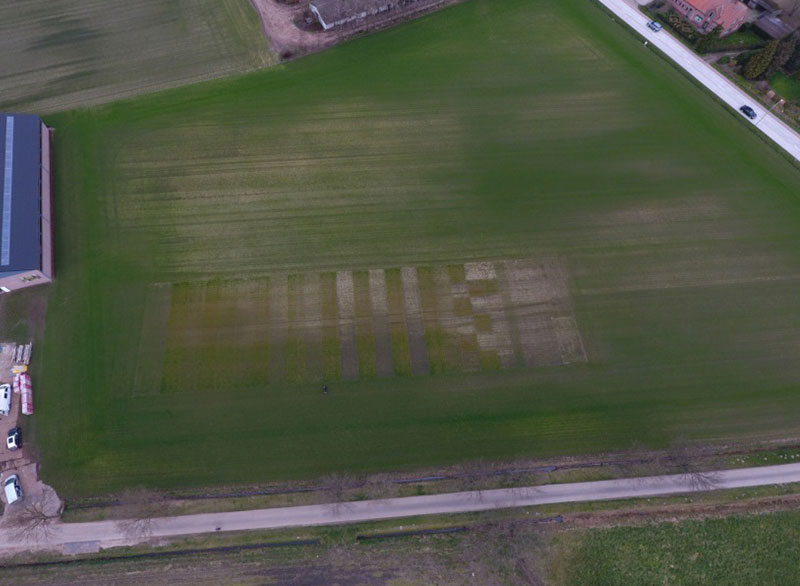
Fertilization trials, demonstrating the long-acting effect of Sierrablen Plus
Root migration is the critical risk point
Sod is grown on a different soil profile. Once laid, roots must migrate into the native soil beneath. This interface is the most common point of failure during renovation.
Poor rooting is typically caused by:
- Nutrients remaining concentrated at the surface
- Inconsistent moisture movement between soil layers
Both delay root penetration and increase instability under load.
Nutrition should drive roots downward
During sod establishment, nutrition must support root development without forcing excessive leaf growth. Nitrogen availability should be controlled, while phosphorus availability is essential to stimulate root initiation and extension.
Controlled-release, mini-granular fertilizers deliver nutrients into the soil profile, encouraging roots to migrate downward rather than remain in the sod layer. Products such as Sierrablen Plus and Sportsmaster are designed to provide sustained nutrient availability during this critical grow-in period, supporting anchorage and resilience rather than short-term color.
Moisture uniformity enables establishment
Differences in moisture behavior between the sod layer and native soil can restrict rooting at the interface. Uniform wetting through both profiles is essential to remove this barrier.
Profile-active wetting agents, including H2Pro AquaSmart, help move water consistently through the soil profile, improving moisture distribution and supporting root penetration during establishment. This not only accelerates sod knit-in but also improves water-use efficiency during renovation.
The wider H2Pro wetting agent range, including H2Pro TriSmart and H2Pro FlowSmart, has been developed to address varying soil and moisture challenges encountered during renovation and grow-in.
The objective is surface stability, not speed
Whether overseeding or re-turfing, the goal of renovation is a surface that can tolerate play without shifting, thinning, or tearing.
That stability depends on:
- Rapid root migration into the soil profile
- Consistent moisture movement through soil layers
- Controlled, root-focused nutrition during establishment
When these fundamentals are addressed, renovated surfaces recover faster and tolerate earlier use with reduced risk.