


 Whatsapp
  X
X  Mail
Mail  Copy link
 Spyder 2LS: tall fescue cultivar profile

On this page:
Tall fescue is naturally a bunch-type grass, but individual cultivars can differ considerably in their ability to produce tillers, maintain density and recover after thinning or wear.
Spyder 2LS is a second-generation turf-type tall fescue developed through Mountain View Seeds’ Lateral Spread™ (LS™) breeding program. It combines fine leaf texture and dark green color with selection for increased stand density and recovery, supported by strong results in National Turfgrass Evaluation Program (NTEP) testing.
Spyder 2LS at a glance
| Species | Tall fescue (Festuca arundinacea) |
| Breeding | US |
| Leaf color | Dark green |
| Leaf texture | Fine |
| Growth habit | Bunch-type with increased tillering and lateral growth |
| Key strengths | Turf quality, density and traffic tolerance |
| Disease tolerance | Brown patch |
| Additional characteristic | Turf quality, wear performance and spring green-up |
| Wear and recovery | Selected through the Lateral Spread™ (LS™) breeding program for increased stand density and recovery |
| Typical uses | Sports turf, landscape turf, renovation and overseeding |
What is Lateral Spread™ Technology?
Tall fescue is fundamentally a bunch-type grass, with growth that is predominantly vertical rather than lateral.
However, individual plants vary in their ability to produce new shoots, or tillers, that increase plant and stand density.
Mountain View Seeds developed its Lateral Spread™ (LS™) research program to identify tall fescues with greater potential for increased stand density, particularly under stress, and improved recovery following traffic, thinning or injury.
The program involved screening thousands of individual plants and combining promising selections through repeated cycles of selection. Some selections were also observed producing rhizomes capable of forming new plants alongside the parent plant.
Spyder 2LS is a second-generation cultivar from this breeding approach. Its LS™ background therefore reflects selection for growth characteristics that can help tall fescue fill newly seeded areas and recover coverage where turf has been thinned by wear or environmental stress.
LS™ should not be interpreted as meaning Spyder 2LS behaves like an aggressively rhizomatous turfgrass. The important distinction is greater potential for tillering, stand density and lateral growth within a turf-type tall fescue.
What does the NTEP evidence show?
Spyder 2LS has been evaluated through the US National Turfgrass Evaluation Program, providing comparative data across several characteristics relevant to turf performance.
| Characteristic | Spyder 2LS rating |
|---|---|
| Turf quality – LPI Group 1 mean | 6.9 |
| Turf quality under traffic stress | 6.8 |
| Summer density | 7.0 |
| Fall density | 7.2 |
| Brown patch tolerance | 6.9 |
Ratings use a 1–9 scale, with 9 representing the highest rating. The figures above come from different NTEP datasets collected in 2019 and 2020.
The useful point is the combination. Spyder 2LS performed strongly across turf quality, density, traffic stress and brown patch tolerance rather than relying on a single characteristic.
Strong density through the growing season
Density is particularly relevant to Spyder 2LS because it connects directly with the objective of the Lateral Spread™ breeding program.
Spyder 2LS recorded mean NTEP density ratings of 7.0 in summer and 7.2 in fall.
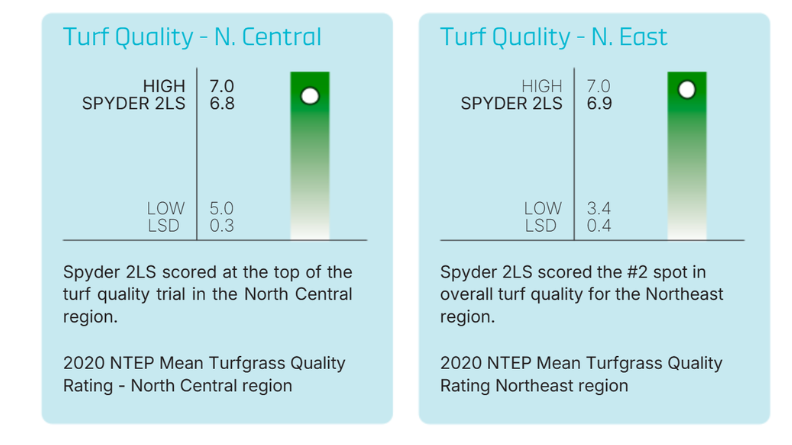
Spyder 2LS turf-quality performance in the 2020 NTEP North Central and Northeast regional trials.
For the turf manager, density is about more than the number of shoots produced by an individual plant. A denser stand provides more complete ground coverage, contributes to a more uniform turf surface and leaves less open space for weeds to establish.
That makes Spyder 2LS particularly relevant where maintaining coverage and stand density are important parts of the turf specification.
Turf quality under traffic
Density becomes even more valuable where turf is exposed to regular use.
In the cited 2020 NTEP traffic trial at Ames, Iowa, Spyder 2LS recorded a 6.8 turf quality rating under traffic stress.
This supports the wider objective of the LS™ breeding program, which includes selection for the ability to maintain density and recover following traffic, thinning and injury.
For turf managers, the practical value is the combination of a dense stand with independently measured performance under traffic stress.
Brown patch tolerance
Disease tolerance is another useful differentiator between tall fescue cultivars, particularly where warm and humid conditions increase brown patch pressure.
Spyder 2LS recorded a mean brown patch tolerance rating of 6.9 in the cited 2020 NTEP data.
Disease development will still depend on environmental conditions and management, so this should not be interpreted as resistance to infection or a guarantee of disease-free turf. It does provide another independently evaluated characteristic to consider when comparing tall fescue cultivars.
Fine leaf texture with strong turf quality
Spyder 2LS combines its density and LS™ characteristics with fine leaf blades and naturally dark color.
Its appearance is also supported by regional NTEP turf-quality results. Spyder 2LS recorded mean NTEP turf-quality ratings of 6.8 in the North Central region and 6.9 in the Northeast region.
This combination is useful where tall fescue is being selected for the quality of the finished turf as well as durability and coverage.
Establishing Spyder 2LS
Tall fescue benefits from sufficiently warm soil during establishment. The supplied guidance identifies a preferred soil temperature of approximately 12–15°C.
For new establishment, Spyder 2LS is recommended at 30–50 g/m². Seed should be lightly covered and kept moist during establishment.
For overseeding existing tall fescue, the recommended rate is 25–35 g/m².
Actual establishment speed will depend on soil temperature, moisture, seedbed preparation and local growing conditions.
When should you choose Spyder 2LS?
Spyder 2LS is particularly relevant where stand density, turf quality and performance under traffic need to be considered together.
Its Lateral Spread™ background provides an important point of difference. Mountain View Seeds specifically selected tall fescue plants showing greater potential for density and recovery, while NTEP testing provides supporting evidence for Spyder 2LS across density, turf quality and traffic performance.
For turf managers comparing tall fescue cultivars, the decision is therefore not simply about color or appearance. Spyder 2LS offers a combination of fine leaf texture, dense growth, traffic performance and selection for improved recovery and coverage.
Spyder 2LS in the ProSelect range.
Spyder LS is used in selected ProSelect grass seed blends. Product availability and blend compositions vary by country, so please check your local ProSelect grass seed ranges for details.

