


 Whatsapp
  X
X  Mail
Mail  Copy link
 JCB Golf & Country Club Chooses Riptide for its Greens
After on-site trials comparing six grasses from six suppliers, the team selected Riptide creeping bentgrass for the new putting greens at JCB Golf & Country Club in Staffordshire, UK.
On this page:
When JCB Golf & Country Club was being developed in Staffordshire, England, the greenkeeping team was involved in the construction and establishment of the new 18-hole course.
For Golf Course Manager Callum Wark and the wider team, the aim was to establish putting surfaces capable of meeting the expectations of a high-end golf facility.
“This is a high end facility that people might only visit once a year or even just once in their lifetime. The whole experience has to be there and it is down to us to deliver that on the golf course,” said Callum.

Callum Wark, Golf Course Manager, JCB
Building the course
Designed by British architect Robin Hiseman of European Golf Design, the course was constructed on a heavy clay site.
Members of the greenkeeping team were directly involved in the construction process, giving them experience of the course from the ground up.
“Myself and four senior greenkeepers were equally involved in all aspects of construction,” said Euan Grant, General Manager.
“We had all been around constructions in the past but none of us had ever had direct construction experience. For greenkeepers to jump on excavators and dumpers, and to be ploughing and turning soils over is really quite remarkable.
“It is a heavy clay site so we had to work when it was dry. If we got two days of rain then we couldn’t work for ten days and if that meant working at 8 o’clock on a Sunday night then we were working at 8 o’clock on a Sunday night.”
As construction progressed, the focus moved towards establishing the playing surfaces.
“The tournaments will happen but first of all we need to achieve agronomic excellence,” said Euan.
“In order to achieve that, and in order to host tournaments, you have to be in that top percentile of golf course reputation and quality,” added Callum.
Trialing grasses for the greens
The team did not select the grass for the greens on specification alone. Euan established a nursery trial to compare potential options under conditions at JCB.
The nursery was divided between five different rootzone treatments: a porous ceramic product, a green waste product, two zeolite products and straight sand. Six grasses from six different suppliers were then applied across the plots.
The team monitored germination, density, color and disease. Fungicides were withheld during the winter so they could also observe disease development.
“We monitored the germination rates, density, colour and disease to find out which product would be the best for our site,” said Euan.
“We didn’t put any fungicides on them throughout winter because we wanted to know which diseases would be more prevalent.”
The trial gave the team the opportunity to compare the grasses under its own growing conditions before making a decision for the new greens.
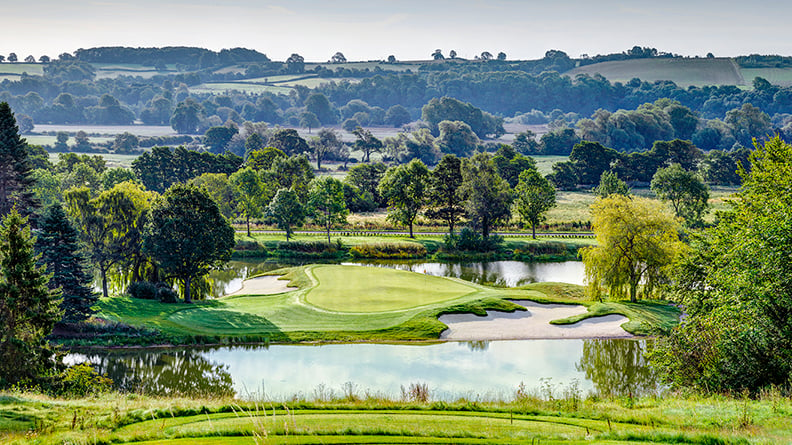
JCB Golf & Country Club
Selecting Riptide creeping bentgrass
Based on the results of the trial and the condition of the grasses coming out of winter, the team selected ICL Riptide creeping bentgrass (Agrostis stolonifera).
“Based on all of the results, and also by looking closely at which was the strongest grass coming out of winter, we decided that we would go with ICL’s Riptide on a green waste compost / sand mix as per USGA specification,” said Euan.
Riptide is a fine-leaved, densely shooting creeping bentgrass for golf putting greens. Its growth characteristics make it suitable for the close mowing and high shoot density required on high-quality putting surfaces.
It can be used to establish new greens or for interseeding existing surfaces as part of a renovation program.
At JCB, its selection followed the team’s own comparison of Riptide with grasses from other suppliers, with the final decision based on the characteristics they observed on site.
Establishing the greens
Riptide was sown at 6–8 g/m². The team used it to establish 11 greens in the first year and a further nine the following year.
Euan highlighted the speed of establishment they experienced during the grow-in.
“We were germinating in five days and mowing in ten days,” he said.
“Because it was our first year and it was a soft opening, we were under no pressure whatsoever to cut the grass down to achieve fast speeds. However, we were still getting 10.5ft without significantly chasing that. It is an incredibly fine grass.”
These figures describe the team’s experience under the conditions and management practices at JCB rather than results from a controlled trial.
Early performance at JCB
Root development was another characteristic the team highlighted after establishing the greens.
“We haven’t looked back,” said Callum.
“The rooting has been amazing – we are 300mm of rootzone over 100mm gravel and even now, a year on from opening, the roots are way down into the gravel. They are incredibly strong roots.”
The experience at JCB shows the value of testing potential cultivars under local conditions before making a large-scale establishment decision.
For the JCB team, comparing germination, density, color, disease and winter performance across six grasses provided the information they needed to select Riptide for the new putting greens.


