Whatsapp
  X
X  Mail
Mail  Copy link
 What Is a Block Copolymer in a Wetting Agent?
How block copolymers influence wetting-agent performance, residual activity and water management in the turf rootzone.

On this page:
Block copolymers are one of the main surfactant technologies used in many residual wetting agents.
Unlike the shorter-chain surfactants used in many penetrant wetting agents, block copolymers are designed to remain active within the rootzone for longer.
This residual activity helps improve water distribution and reduce the development of localized dry spot (LDS) between applications.
Understanding how block copolymers work helps explain why different wetting agents perform differently, and why surfactant technology is often more important than simply choosing a product for summer or winter use.
What is a block copolymer?
A block copolymer is a long-chain surfactant made from connected sections, or blocks, with different properties.
In wetting-agent formulations, these include hydrophilic (water-attracting) and hydrophobic (water-repelling) blocks arranged along the same molecule.
This combination allows the surfactant to interact with both water and water-repellent areas within the rootzone, helping water distribute more evenly through treated soil.
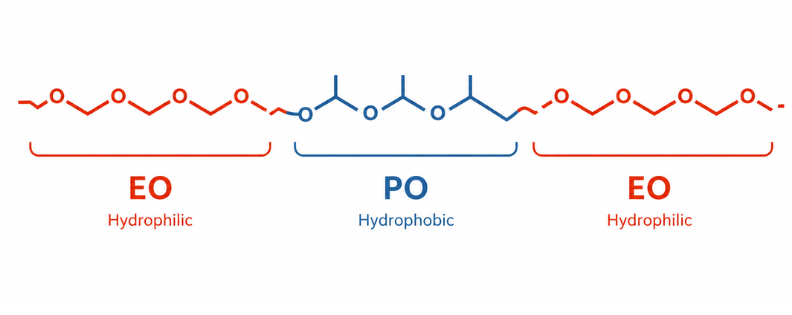
A simplified illustration of an EO–PO–EO triblock copolymer consisting of two hydrophilic ethylene oxide (EO) blocks separated by a hydrophobic propylene oxide (PO) block.
Why are block copolymers used?
The role of a block copolymer is not simply to help water spread.
Because these molecules are generally longer-chain surfactants, they remain active in the rootzone for longer than many shorter-chain penetrant surfactants.
This residual activity allows the wetting agent to continue influencing how water behaves between applications, making block copolymers well suited to products designed to improve moisture distribution over time.
How are block copolymers different from penetrant surfactants?
Different surfactant technologies are designed to achieve different objectives.
Penetrant surfactants primarily reduce the surface tension of water, helping it spread, infiltrate and move through the profile.
Many penetrant formulations are based on relatively short-chain surfactants that move through the rootzone with the water they are helping transport.
Block copolymers perform a different role. Their longer-chain structure allows them to remain active in the rootzone for longer, making them better suited to wetting agents designed to provide residual activity between applications.
Rather than selecting wetting agents simply as “summer” or “winter” products, ICL’s approach is to match the surfactant technology to the water-management objective.
Why combine different surfactant technologies?
Different water-management objectives may benefit from different surfactant technologies.
A product based only on penetrant surfactants can help move water quickly through the profile but may provide little residual activity once the water has moved.
Combining a penetrant surfactant with a block copolymer brings together two complementary functions.
The penetrant component lowers surface tension and encourages water movement, while the block copolymer remains active in the rootzone to support moisture distribution between applications.
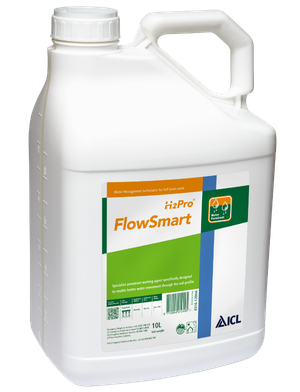
H2Pro FlowSmart uses this combination to provide both immediate water movement and residual activity
Do all wetting agents contain block copolymers?
No.
Wetting agents use different surfactant technologies depending on the objective they are designed to achieve.
Residual wetting agents commonly use block copolymers to provide longer-lasting activity within the rootzone. Penetrant wetting agents are more commonly based on shorter-chain surfactants designed to encourage rapid water movement.
Some formulations combine both technologies to provide immediate water movement and residual activity.
Understanding these differences makes it easier to select a wetting agent according to the water-management objective, rather than simply by season or product type.