Whatsapp
  X
X  Mail
Mail  Copy link
 What Is a Penetrant Wetting Agent?
How penetrant wetting agents help water move through the turf rootzone and potentially support firmer, more playable surfaces during wetter conditions.

On this page:
A penetrant wetting agent is used when the objective is to help water move into and through the turf rootzone.
It works by lowering the surface tension of water. This allows water to spread more readily across soil and sand particles and move through available pore spaces, rather than remaining close to the surface.
For turf managers, the practical benefit is better water movement during wetter conditions, helping to support surface drying, firmness and playability.
How does a penetrant wetting agent help water move?
Water naturally holds together, which is why droplets bead on a surface. Wetting agents reduce this surface tension, allowing water to spread more readily.
Penetrant wetting agents reduce surface tension to a greater degree, helping water spread across a larger area and move more readily into and through the rootzone.
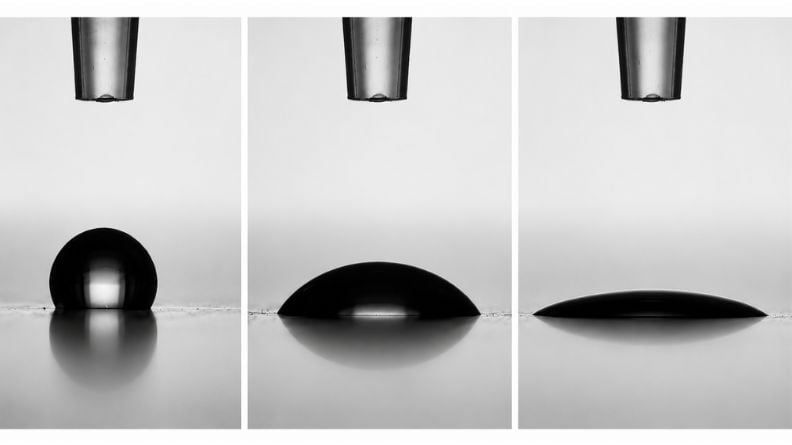
Droplet comparison showing how lower surface tension allows water to spread across a greater surface area.
This difference can be measured under laboratory conditions. In contact-angle testing on a hydrophobic surface, water produced an angle of around 110°, compared with 37° for H2Pro FlowSmart. The lower contact angle shows that the same volume of liquid spreads across a greater surface area rather than remaining as a tight bead.
In a separate dry sand-column demonstration, surface moisture was measured at approximately 34% where water alone was applied, compared with around 6% where FlowSmart helped water continue moving through the profile.
These laboratory results demonstrate the effect of FlowSmart on water spreading and movement. Performance under field conditions will also depend on factors such as rootzone construction, compaction, saturation and the capacity of the drainage system.
How are penetrant wetting agents different?
Wetting agents should not simply be divided into “summer” and “winter” products. A more useful approach is to select them according to the role they need to perform.
Residual wetting agents primarily act within the soil to reduce water repellency, improve moisture distribution and help prevent the development of localized dry spot.
Penetrant wetting agents act more directly on the water itself. By lowering surface tension, they help water infiltrate and move through the profile.
This makes penetrant wetting agents particularly relevant during wetter periods, when the main objective is not to retain moisture but to keep it moving.
When might a penetrant wetting agent be used?
Penetrant wetting agents are commonly used through autumn and winter, when rainfall and lower evaporation rates can leave turf surfaces holding excess moisture.
They may be used:
- As part of a planned autumn and winter water management program.
- Ahead of forecast rainfall.
- Where surface moisture is affecting firmness or playability.
- Alongside other practices designed to manage moisture around the leaf, crown and rootzone.
Application programs can be flexible. Regular applications may suit some sites, while others may choose to apply ahead of significant rainfall events. The important point is to match the application to the conditions and the management objective.
Can a penetrant wetting agent improve drainage?
A penetrant wetting agent can help water infiltrate and move through a rootzone, but it does not create drainage where none exists.
Water will only move if there is somewhere for it to go. If the rootzone is fully saturated, heavily compacted or affected by poor underlying drainage, a penetrant wetting agent will not correct the underlying problem.
This distinction matters. Penetrant wetting agents should be viewed as a tool for improving water movement within a functioning drainage system, not as a replacement for physical drainage or sound rootzone management.
Can penetrant wetting agents control localized dry spot?
A penetrant wetting agent may help alleviate some localized dry spot symptoms because it can help water enter and move through water-repellent areas.
However, it is not normally the first choice where the main objective is long-term localized dry spot management.
Residual wetting agents are designed specifically to remain active in the rootzone and manage water repellency over a longer period. Where localized dry spot is the primary problem, a residual wetting agent program is generally the more appropriate approach.
The choice should always be based on the problem being managed.
Why does formulation matter?
Penetrant wetting agents are often based on relatively short-chain surfactants. These act quickly on water but also tend to break down or move through the rootzone relatively quickly.
This means that not all penetrant wetting agents perform in exactly the same way.
ICL’s approach with H2Pro FlowSmart is to combine penetrant surfactant technology with a block copolymer. The penetrant component helps reduce surface tension and get water moving, while the block copolymer provides some residual activity between applications.
This combined approach allows FlowSmart to support immediate water movement while also contributing to a planned water management program.
Supporting water movement with H2Pro FlowSmart
H2Pro FlowSmart is designed to help water infiltrate and move through the rootzone, supporting surface drying under wet conditions.
Its formulation lowers the surface tension of water to promote spreading and movement, while the residual component helps maintain activity between applications.
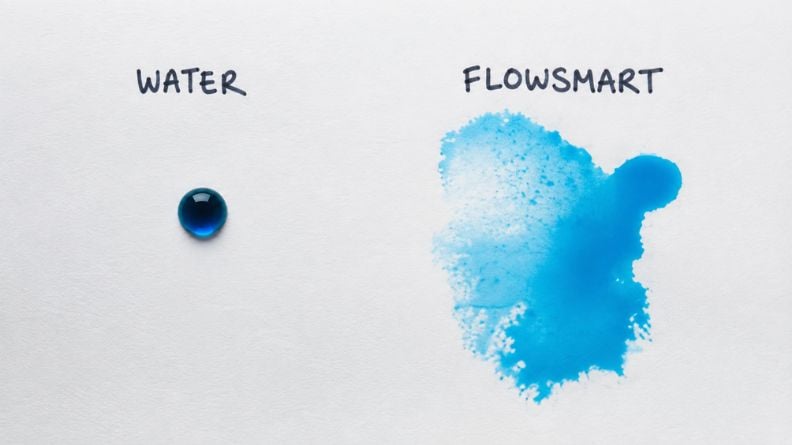
Comparison showing how H2Pro FlowSmart spreads across a greater surface area than water alone.
Used as part of an integrated water management program, FlowSmart can help turf managers manage excess surface moisture more effectively and support firmer, more playable surfaces through wetter periods.
Explore FlowSmart and speak to your ICL technical representative about building a water-management program for wetter conditions.