Whatsapp
  X
X  Mail
Mail  Copy link
 Choosing the right spreader
This article will help you choose the correct spreader for your needs.
On this page:
Selecting the right spreader matters because it directly affects accuracy, efficiency, and consistency of application. Different spreader types suit different situations, and there is no single option that works best everywhere. The right choice depends on the area being treated, the material being applied, and how much control is needed.
ICL’s Spreader Index (available via the link above) provides a full overview of the range and can be used alongside the guidance below to narrow down the most suitable option.
Rotary spreaders
Rotary, or broadcast, spreaders are commonly used where speed and coverage are the priority. Material is delivered onto a spinning plate and distributed across a wide area.
They are well suited to large open surfaces such as golf courses, sports pitches, and expansive lawns, where covering ground efficiently matters. Most models allow adjustment of spread width, which helps when working around boundaries or avoiding non-target areas, although this still requires careful operation to prevent overlap or drift.
Rotary spreaders perform well with most granular products, including coated fertilisers, seed, and granular wetting agents. Precision is lower than with a drop spreader, particularly when handling very fine materials, so calibration and operator technique play a bigger role.
Drop spreaders
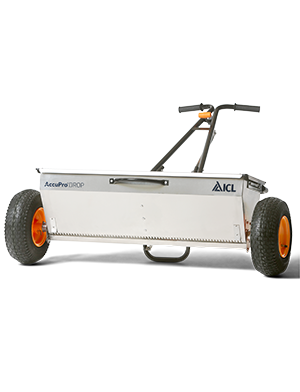
Drop spreaders are designed for controlled, accurate application. Granules are released directly beneath the spreader, across a fixed width, which limits lateral movement and reduces the risk of material reaching unwanted areas.
This makes them a good option where accuracy is critical, such as along edges, around features, or in smaller or confined spaces. Distribution is consistent across the spread width, provided walking speed and settings are kept steady.
The trade-off is speed. Coverage is slower than with a rotary spreader, and larger areas require more passes. Where precision outweighs efficiency, this is usually an acceptable compromise.
Hand-held spreaders
Hand-held spreaders are intended for small-scale or localised use. They are lightweight, easy to manoeuvre, and useful where access is limited or where only small quantities of material are being applied.
They are commonly used for spot treatments, small lawns, gardens, or touch-up work. Capacity is limited, so frequent refilling is unavoidable, and consistency depends heavily on the operator. For larger areas or repeat applications, they are rarely the most practical option.
Making the choice
Choosing between a rotary, drop, or hand-held spreader comes down to balancing area size, required accuracy, material type, and working conditions. In many programmes, more than one spreader type is used across the season to suit different tasks rather than relying on a single solution.