


 Whatsapp
 X
X
 Linkedin
 Mail
Mail
 Copy link
 MTU® and Pidolic Acid Under Drought Stress
University of Pisa 1970
Key Conclusions
A single application of combined MTU® and pidolic acid (0.2L/ha) was compared to untreated control and to a seaweed extract (10L/ha) prior to onset of drought stress imposed by deficit irrigation.
The combined MTU® and pidolic acid significantly (P<0.05) improved turfgrass quality under drought stress and significantly improved a number of turf stress metrics including total antioxidant capacity, amount of photosynthetic pigments and photosystem II activity.
Objective
To evaluate the effect of a single combined application of MTU® and pidolic acid on turf performance and physiological stress responses in creeping bentgrass under increasing levels of drought stress, compared with an untreated control and a seaweed extract reference treatment.
Trial Details
Trial station
University of Pisa
Assessments
Mean visual turf quality, shoot and root biomass, and plant physiological performance.
Treatments
- Uniform cores of Agrostis stolonifera ‘T-1’ were collected from a mature sand-based putting green and maintained under controlled greenhouse conditions.
- Plants were subjected to three irrigation regimes, fully watered (100 percent), moderate drought (75 percent), and moderate to severe drought (50 percent of pot capacity), over a 21-day period.
- Treatments included a combined application of MTU® and pidolic acid, a seaweed extract comparator, and an untreated control. Applications were made directly to the rootzone, with nitrogen supplied once at the start of the trial.
- The experiment followed a randomized complete block design with seven replicates per treatment. Turf quality and physiological responses were assessed through destructive measurements at the end of the trial period.
Treatments
- Uniform cores of Agrostis stolonifera ‘T-1’ were collected from a mature sand-based putting green and maintained under controlled greenhouse conditions.
- Plants were subjected to three irrigation regimes, fully watered (100 percent), moderate drought (75 percent), and moderate to severe drought (50 percent of pot capacity), over a 21-day period.
- Treatments included a combined application of MTU® and pidolic acid, a seaweed extract comparator, and an untreated control. Applications were made directly to the rootzone, with nitrogen supplied once at the start of the trial.
- The experiment followed a randomized complete block design with seven replicates per treatment. Turf quality and physiological responses were assessed through destructive measurements at the end of the trial period.
Results
Results overview Analysis of biometric, physiological, and biochemical parameters showed a significant interaction between irrigation level and treatment, indicating that treatment response varied with drought severity.
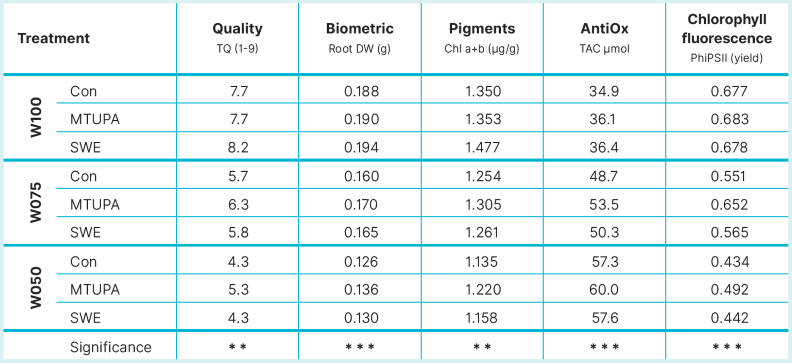
Table 1: Selected trial results for Control (Con), MTU® & Pidolic Acid (MTUPA) and Seaweed Extract (SWE) under three levels of drought stress. Well-watered (W100), moderate stress (W75), severe stress (W50).
- Turf quality and growth Under well-watered conditions (W100), the seaweed extract produced the highest visual and growth responses. As drought stress increased (W75 and W50), turf quality declined across all treatments. Under moderate and severe drought, MTU® plus pidolic acid maintained higher visual quality and biomass than both the untreated control and seaweed extract, with improvements of up to 23 percent in colour and 22 percent in overall quality compared with the control.
- Photosynthetic pigments Pigment concentrations declined with increasing drought across all treatments. However, turf treated with MTU® plus pidolic acid retained significantly higher chlorophyll levels under moderate and severe drought, indicating improved preservation of photosynthetic capacity under stress.
- Photosynthetic efficiency Photosystem II efficiency (ΦPSII) decreased as drought severity increased. MTU® plus pidolic acid consistently maintained higher ΦPSII values under water-limited conditions, particularly under severe drought, indicating better protection of photosynthetic function.
- Antioxidant response Drought stress increased antioxidant activity in all treatments. MTU® plus pidolic acid induced the strongest antioxidant response under moderate and severe drought, suggesting enhanced protection against oxidative stress.
