


 Whatsapp
 Facebook
 Mail
Mail
 Copy link
 SMX based seaweed can reduce plant parasitic nematode infection
Royal Holloway University, London 1970
Key Conclusions
An independent trial at Royal Holloway University, London, completed as part of a PhD by Dr Tamsin Williams demonstrated that six weekly applications of SMX seaweed at a recommended rate, significantly reduced populations of PPN compared to a water only control. This trial supports previous work in this area suggesting that alkaline extracted seaweed, in this case Sportsmaster WSF SMX would be a useful application for the management of plant parasitic nematodes in sports turf situations.
Objective
To see if preventative applications of SMX based seaweed can reduce plant parasitic nematode infection
Trial Details
Trial station
Royal Holloway University, London
Assessments
Population of plant parasitic nematodes in turfgrass
Treatments
Each of the 18 cores were split, and secured in plastic tubes to provide matched pairs for treatment. The trial was completed in glasshouse conditions under grow lights on a 16:8 day night cycle. Within each pair one randomly selected half-core was treated weekly with SMX seaweed powder (Sportsmaster WSF SMX, ICL), at an equivalent rate of 1 kg/ha in 500L water. The remaining half-core was treated with water. Cores were trimmed weekly at 10 mm. After six weeks (six applications) a 250 g sample was collected from the rooting zone 0–60 mm and nematode population extracted.
Treatments
Each of the 18 cores were split, and secured in plastic tubes to provide matched pairs for treatment. The trial was completed in glasshouse conditions under grow lights on a 16:8 day night cycle. Within each pair one randomly selected half-core was treated weekly with SMX seaweed powder (Sportsmaster WSF SMX, ICL), at an equivalent rate of 1 kg/ha in 500L water. The remaining half-core was treated with water. Cores were trimmed weekly at 10 mm. After six weeks (six applications) a 250 g sample was collected from the rooting zone 0–60 mm and nematode population extracted.
Results
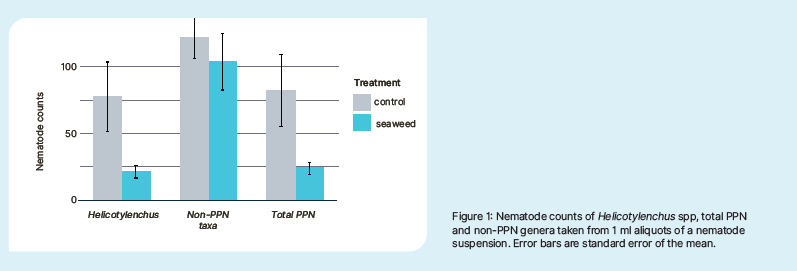
The plant parasitic nematode Helicotylenchus spp (spiral nematode) was the dominant PPN found in the cores, alongside a mixed population of non-PPN taxa. There was a significant difference between control and SMX seaweed treated groups for PPN (P<0.01), but this was not seen for non-PPN species (P>0.05) (Figure 1).
An examination of each pair of split cores (Figure 2) shows that when PPN populations are high (cores c, g, h, i, I, & q), the application of SMX seaweed drastically reduces the population, compared to the water-only control split-core. Where populations are much lower (the remaining 12 cores) there is not a large difference between treated and untreated.

Related Trials

Our knowledge
Tips & tricks, disease prevention, scientific results and more
Explore our knowledge hub