


 Whatsapp
 X
X
 Mail
Mail
 Copy link
 Osmocote 5 Optimizes Nutrient Use Efficiency
Less N leaching
VuB Ellerhoop, Germany
Less N leaching
Key Conclusions
- All treatments received equal total nitrogen, yet nutrient losses differed sharply between fertilizer types.
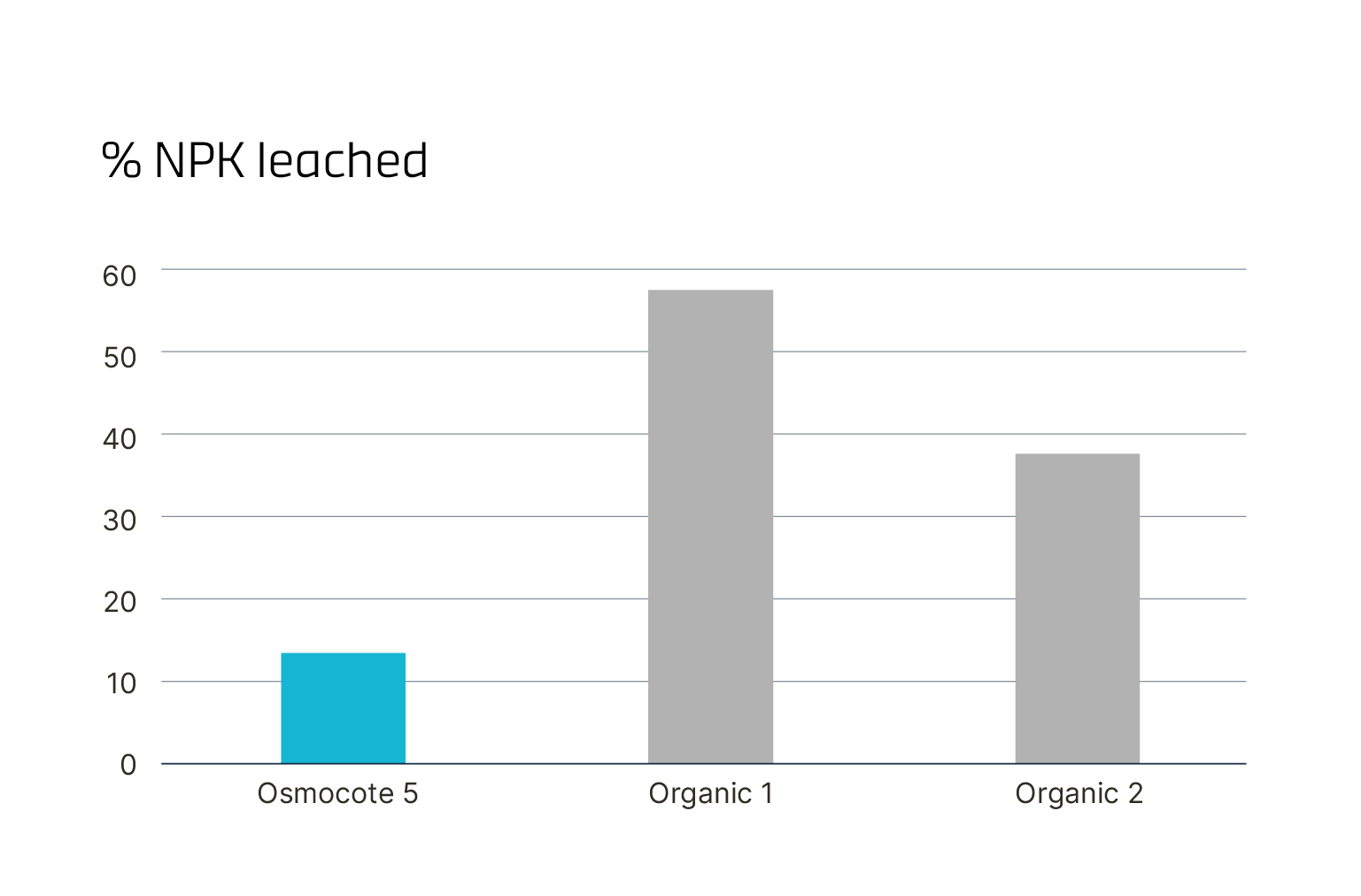
- Osmocote 5 showed superior nutrient retention, with only 14% of total NPK input leaching out over 14 weeks.
- Organic fertilizers required higher dose rates to match nitrogen input but still lost 38–57% of their total NPK.
- Even in a dry season with low drainage, coated controlled‑release technology minimized nutrient leaching far more effectively than organic fertilizers.
- The trial confirms that Osmocote 5 optimizes nutrient use efficiency, keeping nutrients available in the substrate and reducing environmental losses.
Objective
To compare nutrient leaching from coated, controlled‑release fertilizer (Osmocote 5) with organic fertilizers when all treatments receive the same total nitrogen input, and to evaluate how fertilizer type influences nutrient use efficiency under real pot‑trial conditions.
Trial Details
Trial station
VuB Ellerhoop, Germany
Product
Osmocote 5
Assessments
nutrients contained in the leachate
Treatments
The trial compared Osmocote 5 with two organic fertilizers to evaluate nutrient leaching under equal nitrogen input. All fertilizers were mixed into the substrate at dose rates calibrated to deliver the same total nitrogen per liter of substrate. Eight pots per treatment were placed in leachate‑collection pipes to capture all drainage water.
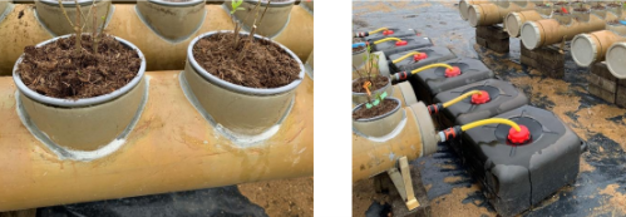
Pots were placed inside vertical pipes, allowing all drainage water to be directed into collection cans for accurate measurement of leachate volume and nutrient content.
Over a 14‑week period, the volume of leachate was recorded weekly, and samples were analyzed for NPK concentrations. The setup allowed precise measurement of nutrient losses from each fertilizer type. The trial was conducted with three replicates to ensure reliable comparison between the coated controlled‑release fertilizer and the organic fertilizers.
| Product | Dose rate | NPK-analysis | Total N (mg/l substrate) |
|---|---|---|---|
| Osmocote 5 5-6M | 4 g/l | 16-8-12 | 640 |
| Organic 1 | 7.5 g/l | 8.5-3-5 | 637 |
| Organic 2 | 10.6 g/l | 6-3-4 | 636 |
Treatments
The trial compared Osmocote 5 with two organic fertilizers to evaluate nutrient leaching under equal nitrogen input. All fertilizers were mixed into the substrate at dose rates calibrated to deliver the same total nitrogen per liter of substrate. Eight pots per treatment were placed in leachate‑collection pipes to capture all drainage water.
Pots were placed inside vertical pipes, allowing all drainage water to be directed into collection cans for accurate measurement of leachate volume and nutrient content.
Over a 14‑week period, the volume of leachate was recorded weekly, and samples were analyzed for NPK concentrations. The setup allowed precise measurement of nutrient losses from each fertilizer type. The trial was conducted with three replicates to ensure reliable comparison between the coated controlled‑release fertilizer and the organic fertilizers.
| Product | Dose rate | NPK-analysis | Total N (mg/l substrate) |
|---|---|---|---|
| Osmocote 5 5-6M | 4 g/l | 16-8-12 | 640 |
| Organic 1 | 7.5 g/l | 8.5-3-5 | 637 |
| Organic 2 | 10.6 g/l | 6-3-4 | 636 |
Results
The 2022 season was relatively dry, resulting in lower drainage volumes and therefore reduced overall nutrient leaching from all treatments. Despite these conditions, clear differences emerged between the coated fertilizer and the organic fertilizers.
Across the 14‑week period, Osmocote 5 showed the lowest nutrient losses, with only 14% of its total NPK input leaching out of the pots. In contrast, Organic fertilizer 1 lost 57% of its applied NPK, and Organic fertilizer 2 lost 38%.
Even under low‑leaching conditions, the coated controlled‑release technology of Osmocote 5 retained nutrients in the substrate far more effectively than the organic fertilizers, demonstrating significantly higher nutrient use efficiency.
Other Interesting Trials


Our knowledge
Tips & tricks, disease prevention, crop and market related information
Explore our knowledge