Whatsapp
 X
X
 Mail
Mail
 Copy link
 Reducing disease incidence in fine turf
Harrogate, United Kingdom 2026
Key Conclusions
The trial work demonstrates the expected improved turf quality and turf color achieved on a golf green from increasing the rate of N slightly during a summer and winter period. Also apparent is the reduction in anthracnose experienced from similar N increases.
The trial also demonstrates a significant reduction in disease incidence, of both anthracnose and microdochium when applying a program of improved Greenmaster Liquid Advance, now containing a biostimulant package, in comparison to matched nitrogen inputs of the original product. This difference could potentially be due to improved photosynthesis and a reduction in stress experienced for GMLA plots allowing for better disease resilience.
Objective
To assess whether Greenmaster Liquid Advance can improve turf quality and reduce disease incidence compared with standard liquid nutrition programs on fine turf.
Trial Details
Trial station
Harrogate, United Kingdom
Product
Greenmaster Liquid Advance
Assessments
Visual turf quality, visual turf colour and % area affected by disease.
Treatments
A partially shaded green comprised of an Agrostis capillaris / Poa annua sward with known susceptibility to disease outbreaks was utilized for the trial.
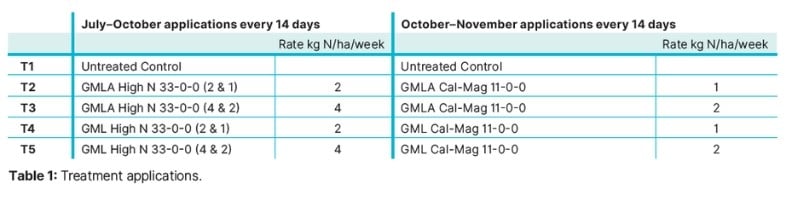
Liquid fertilizer applications were made to the trial plots (Table 1) in a randomized complete block design with four replicates.
Nutrition only was added for summer applications (July–October), however H2Pro FlowSmart @ 10 L/ha (penetrant wetting agent) and Pro Iron Effect (10 L/ha) were added to each application in autumn (October- November).
Turf quality (1-10 scale), turf color (1-10 scale) and turf disease incidence (% affected) assessments were made fortnightly.
Treatments
A partially shaded green comprised of an Agrostis capillaris / Poa annua sward with known susceptibility to disease outbreaks was utilized for the trial.
Liquid fertilizer applications were made to the trial plots (Table 1) in a randomized complete block design with four replicates.
Nutrition only was added for summer applications (July–October), however H2Pro FlowSmart @ 10 L/ha (penetrant wetting agent) and Pro Iron Effect (10 L/ha) were added to each application in autumn (October- November).
Turf quality (1-10 scale), turf color (1-10 scale) and turf disease incidence (% affected) assessments were made fortnightly.
Results
Mean turf quality was significantly greater (P<0.05) than control for higher rate N treatments (T3 & T5) on nearly every assessment occasion (8/9). Higher rate N treatments demonstrated significantly greater (P<0.05) turf quality than lower rate N treatments in general (5/9). GMLA treatments (T2 & T3) demonstrated significantly greater turf quality than GML treatments (T4 & T5) on three occasions (data not shown).
Mean turf color was significantly greater (P<0.05) than control for higher rate N treatments (T3 & T5) on most assessment occasions (6/9). Higher rate N treatments demonstrated significantly greater (P<0.05) turf color than lower rate N treatments occasionally (3/9). GMLA treatments (T2 & T3) demonstrated significantly greater turf color than GML treatments (T4 & T5) on three occasions (data not shown).
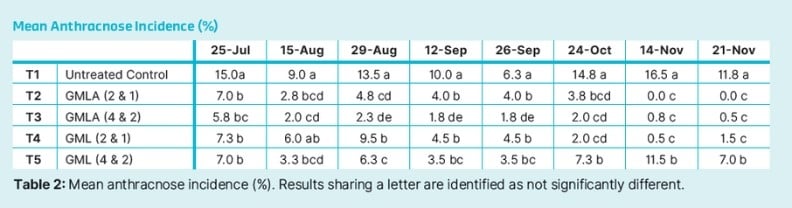
The presence of anthracnose (Colletotrichum cereale) was identified throughout the trial, and addition of nutrition generally significantly reduced the disease with higher rates of nitrogen application showing greater reduction (Table 2). At the lower rate of nutrition there was rarely a difference between GMLA and GML however, at higher rates of nutrition GMLA demonstrated significantly reduced amounts of disease when compared to the matched nitrogen of GML.
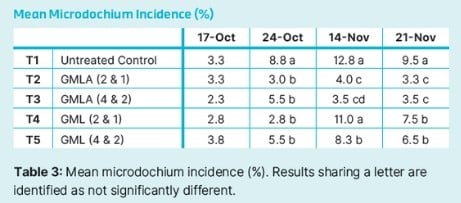
The presence of Microdochium nivale was identified on the last four assessment dates (Table 3) and increased in severity from October to November. The addition of nitrogen in all treatments significantly (p<0.05) reduced the incidence of the disease. On the last two assessment dates GMLA reduced the presence of the disease to a significantly (P<0.05) greater extent than GML treatments.
More trials