Whatsapp
  X
X  Mail
Mail  Copy link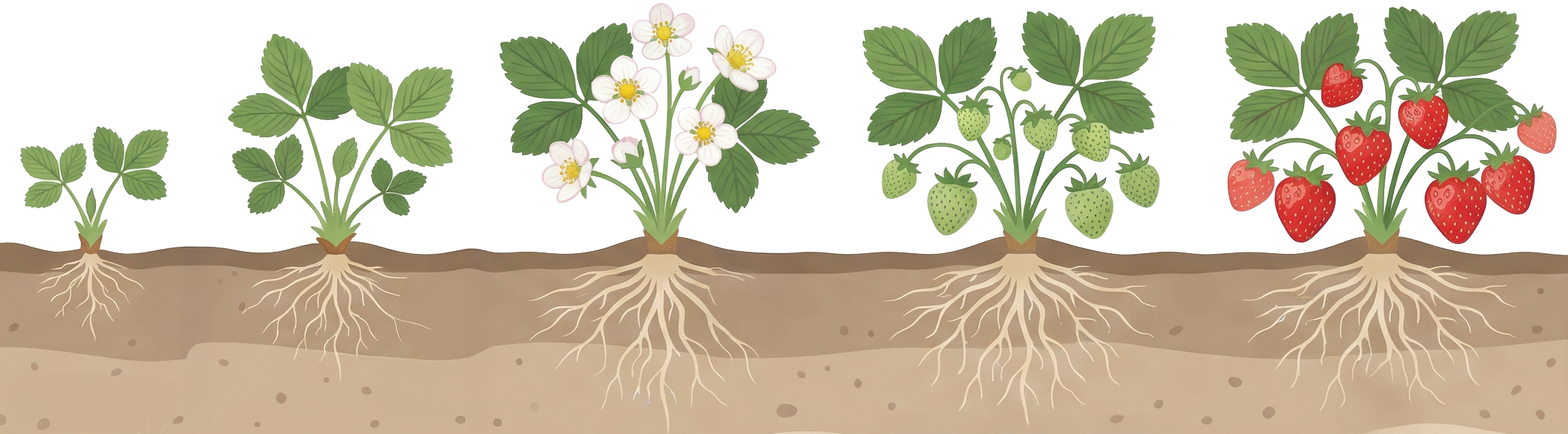

The groundbreaking total range of water-soluble straight fertilizers
Brand details Nova Growing Strawberry
Crop Nutrition Advice
Everything you need to know about strawberry fertilization, best practice, suitable products, field trials and more.
Advice for growing Strawberry (Fragaria ananassa)

Detail of strawberry

View of industrial strawberry crop
Introduction
Strawberry (Fragaria × ananassa) is a relatively young cultivated species, originating in the 18th century from a natural hybrid between the North American Fragaria virginiana and the Chilean Fragaria chiloensis. From these two wild parents came the modern garden strawberry, valued for its aroma, sweetness, and adaptability. Today, strawberries are grown worldwide in open fields, protected structures, and advanced soilless systems, making them one of the most important high‑value berry crops globally.
Strawberry is a shallow‑rooted, high‑value crop that responds strongly to precise nutrition and irrigation management. It performs best in deep, fertile soils rich in organic matter, with a preferred pH of 5.5–6.5. At higher pH levels (>7.5), deficiencies of phosphorus and micronutrients often appear; at lower pH (<5.5), shortages of P, Ca, and Mo are common.
Because strawberries are highly sensitive to root asphyxia, they are typically grown on raised beds or mounds to improve aeration and drainage. Temperatures below 14°C can impair flower development and fruit quality.
The crop’s shallow root system – with 80–90% of roots in the top 15 cm – makes frequent, short irrigation pulses essential. Drip irrigation is the dominant system, enabling precise water delivery and efficient fertigation with fully soluble fertilizers.
Global Strawberry Production
Strawberries are cultivated worldwide, with major production concentrated in:
- China – the world’s largest producer
- USA – especially California and Florida
- Mexico, Egypt, Turkey, Spain, Poland, and South Korea
Global production exceeds 9 million tonnes annually (FAOSTAT, 2023), and demand continues to rise due to year‑round availability, protected cultivation, and expanding fresh‑market consumption.
Uses and Quality Requirements
Strawberries are grown for:
Fruit Production
Strawberries are primarily grown for fresh consumption, which represents the largest share of global demand. Additional markets include processing (frozen berries, jams, purées, concentrates) and premium protected‑cultivation fruit for extended seasons.
Key quality parameters for fruit markets include:
- Size and uniformity
- Firmness and shelf life
- Sugar–acid balance
- Deep, uniform red color
- Aroma and flavor profile
- Resistance to bruising during harvest and transport
Nutrition, irrigation, and substrate management all play a decisive role in achieving these traits.
Nursery and Plant Production
A separate and highly specialized sector focuses on producing strawberry planting material, such as:
- Tray plants
- Plug plants
- Bare‑root plants
- Runner tips
Quality requirements for nursery plants differ from fruit production and focus on:
- Strong, healthy root systems
- Balanced vegetative growth
- Uniform crown size
- High vigor and disease‑free status
- Good transplant establishment
Nutrition programs for nursery plants emphasize controlled vegetative growth, root development, and stress resilience rather than fruit quality.
Strawberry Plant Growth Stages: From Establishment to Harvest
- Establishment – root development, early canopy
- Vegetative growth – leaf expansion, runner control
- Flower initiation – highly sensitive to temperature and nutrition
- Flowering and fruit set
- Fruit development and ripening
- Post‑harvest recovery (in perennial systems)
Each stage has distinct nutrient and irrigation requirements.
Role of Nutrients
Strawberries are highly responsive to balanced nutrition, and each nutrient plays a distinct role in supporting growth, fruit quality, and stress tolerance. Because the crop has a shallow root system and produces high yields in a short season, maintaining a steady and well‑balanced nutrient supply is essential.
Nitrogen is fundamental for vegetative growth and yield formation. It supports protein synthesis and drives canopy development, which in turn influences fruit number and size. However, excessive nitrogen can lead to overly vigorous growth at the expense of fruit firmness and shelf life, so careful management is required throughout the season.
Phosphorus is vital for early root development and is a prerequisite for strong flowering and fruit set. It supports energy transfer within the plant and enhances cell division. Deficiencies are most common in soils with high pH, where phosphorus becomes less available, leading to weak roots, reduced fruit set, and stunted growth.
Potassium plays a central role in sugar transport, water regulation, and enzyme activation. Adequate potassium improves fruit sweetness, color, firmness, and overall yield. It also enhances the plant’s tolerance to abiotic stresses such as drought and heat, and reduces susceptibility to pests and diseases. Because strawberries accumulate large amounts of potassium in the fruit, demand is high throughout the production cycle.
Calcium strengthens cell walls and contributes to fruit firmness, shelf life, and resistance to physiological disorders. Adequate calcium supply helps prevent blossom‑end rot and reduces the incidence of leaf tip burn. Since calcium is not easily redistributed within the plant, continuous availability in the root zone is essential.
Magnesium is the central atom in the chlorophyll molecule and is therefore crucial for photosynthesis. It also supports phosphorus transport and activates numerous enzymes. Adequate magnesium contributes to deep green foliage and good fruit coloration. Deficiencies often appear in fields receiving high nitrogen or potassium rates, which can antagonize magnesium uptake.
Sulfur is a structural component of proteins and enzymes and plays a key role in converting inorganic nitrogen into amino acids. It also contributes to chlorophyll formation and overall metabolic activity. Adequate sulfur improves nitrogen use efficiency and supports healthy, vigorous growth.
Iron is essential for chlorophyll synthesis and energy transfer. Deficiency typically appears as interveinal chlorosis on young leaves and is common in alkaline or calcareous soils, or when over‑liming reduces iron availability. Timely correction is important, as severe deficiency can halt growth and reduce yield.
Manganese supports photosynthesis, particularly the water‑splitting reaction, and contributes to the formation of vitamins such as riboflavin and ascorbic acid. It also plays a role in enzyme activation and carbohydrate metabolism.
Boron is critical for sugar transport, pollination, and seed development. It supports cell wall formation and interacts closely with calcium in maintaining tissue integrity. Adequate boron is essential for good fruit set and uniform berry development.
| N | P₂O₅ | K₂O | MgO | CaO | SO₃ | |
|---|---|---|---|---|---|---|
| Yield | ++ | + | ++ | + | +/– | +/– |
| Fruit size | ++ | +/– | ++ | + | + | +/– |
| Fruit firmness & shelf life | – | +/– | + | +/– | ++ | + |
| Fruit color (external) | +/– | ++ | + | +/– | ||
| Sugar content (°Brix) | + | +/– | ++ | + | + | |
| Acid–sugar balance | + | ++ | +/– | + | ||
| Flowering & fruit set | +/– | ++ | + | +/– | + | |
| Root development | + | ++ | +/– | + | +/– | + |
| Plant vigor | ++ | + | + | + | +/– | + |
| Stress tolerance (abiotic) | +/– | + | ++ | + | + | + |
| Disorders (tip burn, deformation) | – | +/– | ++ | +/– |
++ = strong positive influence
+ = positive influence
+/– = conditional or moderate influence
– = excessive supply has a negative effect
Nutrient Deficiencies
Nitrogen
- Pale, light‑green to yellow leaves
- Reduced vegetative growth and fruit size
- Older leaves show red–purple discoloration
Phosphorus
- Weak roots, stunted plants
- Small, dark, dull leaves
- Purple‑brown leaf margins
- Reduced fruit set
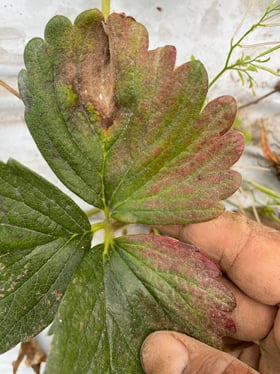

Potassium
- Marginal leaf burn on older leaves
- Reddening and necrosis progressing inward
- Poor fruit quality
Calcium
- Young leaves cup downward
- Scorching and necrosis of growing points
- Flower abortion and reduced fruit size
- Tip burn and puckering
Magnesium
- Interveinal chlorosis on older leaves
- Tan necrosis in severe cases
- Lighter, softer fruits


Iron
- Interveinal chlorosis on young leaves
- Leaves may turn almost white under severe deficiency
- Common in high‑pH or calcareous soils

Severe iron deficiency in strawberry manifests as discoloration of leaves.
Salinity and Chloride Sensitivity
Strawberry is one of the most chloride‑sensitive crops. Symptoms include:
- Dry, brown leaf margins
- Brittle leaves
- Stunted growth
- Root damage and plant death
Thresholds:
- Soil solution Cl⁻: 5–7 meq/L
- Irrigation water Cl⁻: 3–5 meq/L
- Plant tissue Cl⁻: >0.5% DM indicates toxicity
Nutrient Requirements and Fertilization
Strawberries have high nutrient demands concentrated in a short season, with peak uptake during flowering and fruit filling. On average, a 50–60 t/ha crop removes approximately 100–120 kg N/ha, 25–35 kg P₂O₅/ha, and 150–200 kg K₂O/ha, making potassium the dominant nutrient requirement. Calcium uptake is also significant (around 60–80 kg CaO/ha) due to its role in fruit firmness and shelf life. Because 80–90% of the roots are in the top 15 cm, nutrients must be supplied in readily available forms, typically through frequent fertigation with balanced N–K ratios. Controlled‑release fertilizers can provide a reliable base dressing in open‑field systems, while protected and soilless production relies on precise nutrient solutions adjusted to water quality, EC, and pH.
| Nutrient | kg/mt yield |
|---|---|
| N | 2.0–2.5 |
| P₂O₅ | 0.6–0.8 |
| K₂O | 3.0–3.5 |
| MgO | 0.3–0.4 |
| CaO | 0.8–1.0 |
Fertilization Methods
Strawberries respond best to fertilization systems that deliver nutrients frequently and precisely to their shallow root zone. Because drip irrigation is the dominant irrigation method for this crop, most commercial production relies on fertigation, supplying fully soluble fertilizers in small, regular doses. Nutrient programs are adjusted throughout the season to match the crop’s changing N–P–K–Ca–Mg requirements. In soil‑based systems, total nutrient supply comes from a combination of soil reserves, elements present in irrigation water, pre‑plant fertilizer applications, and in‑season fertigation supplements.
Foliar feeding is widely used alongside fertigation, often tank‑mixed with crop‑protection products. It helps correct micronutrient deficiencies and supports the crop under abiotic stresses such as cold soils, drought, or heat, as well as biotic pressures like nematodes and diseases.
The use of controlled‑release fertilizers (CRF) is expanding rapidly, especially in open‑field production where reducing labor and improving nutrient‑use efficiency are priorities. In the USA, more than half of the strawberry acreage now uses CRF as a pre‑plant base dressing. A single application of a well‑designed CRF such as Agroblen® can supply most of the crop’s nutrient needs, with additional water‑soluble fertilizers applied through fertigation when required.
In soilless and protected systems, strawberries perform exceptionally well under intensive fertigation programs. Nutrition formulas are tailored to substrate conditions and water quality, and a water analysis is essential to design accurate nutrient solutions. In these systems, all nutrients must be supplied through irrigation water, with continuous monitoring of EC, pH, and drainage to maintain optimal root‑zone conditions.
Conclusion
Strawberry is a high‑value crop that demands precise agronomy, careful irrigation, and well‑balanced nutrition to achieve premium yields and fruit quality. Its shallow root system, sensitivity to salinity and waterlogging, and rapid fruiting cycle make consistent nutrient availability essential throughout the season. Potassium, nitrogen, and calcium are the dominant drivers of yield, firmness, and shelf life, while phosphorus, magnesium, sulfur, and key micronutrients support root development, flowering, color, and stress resilience.
Modern production relies on drip fertigation, controlled‑release fertilizers, and tailored nutrient solutions in soilless systems to match the crop’s changing requirements from establishment through harvest. When nutrition, irrigation, and substrate conditions are well managed, strawberries respond with strong vegetative growth, uniform fruit set, and high yields of firm, flavorful berries that meet the demands of both fresh and processing markets.
Related Trials
Q&A
Here are some frequently asked questions we received from farmers regarding strawberries.
Generally the first applications of water soluble fertilizer after planting takes place 15 days after planting.
No, You can not mix calcium nitrate with a phosphorus product in the same tank. This may precipitate and clog your drippers. If you do not have two injection tank use Agrolution Special. Agrolution Special is a unique wsf product range with NPK + Ca + MgO in the same product.
Explore Strawberry Solutions by Brand
Find the right solutions to improve crop quality and yield

Fertilizers for Precision Drone Application
Brand details FertiBuzz
The user-friendly, effective NPK water-soluble fertilizer
Brand details SolinureThe groundbreaking total range of water-soluble straight fertilizers
Brand details NovaFertilizers for Precision Drone Application
Brand details FertiBuzzThe user-friendly, effective NPK water-soluble fertilizer
Brand details SolinureDiscover Our Solutions for Growing Strawberry
Strawberry Solutions: Increase Your Harvest
FertiBuzz

Ultra-Low Volume Fertilizer for drone 0-44-36+0.5B+0.2Mn+0.2Zn
See productNova

Nova CalPhos® 0-57-17 (+7CaO)
See productNova

Solinure

Solinure

Digital Tools
Access calculators to improve nutrient management and boost productivity