


 Whatsapp
 X
X
 Mail
Mail
 Copy link
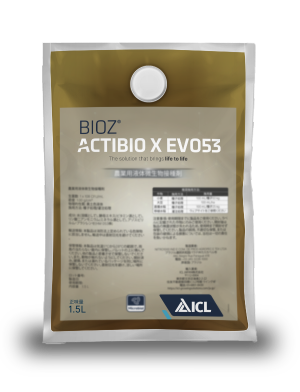


ActiBio EVO53
ActiBio EVO53 is a biological inoculant designed for co-inoculation in soybeans and other crops. This proven agronomic practice, validated by leading Brazilian researchers, has shown consistent benefits in boosting biological nitrogen fixation (BNF), improving productivity, and increasing profitability for farmers.
Most existing Azospirillum brasilense products are based on the AbV5 and AbV6 strains; the former is more efficient at hormone production while the latter is more efficient at nitrogen fixation. ICL's ActiBio EVO53 is the evolution of co-inoculation technology, featuring the new and more efficient Azospirillum brasilense HM053 strain, developed in partnership with ANPIIBio (National Association for the Promotion and Innovation of the Biological Industry).
This new strain offers superior nitrogen fixation and plant hormone production capabilities, delivering superior and more reliable results with a single strain.
ActiBio EVO53 embodies the evolution of biological solutions, becoming increasingly efficient to help farmers achieve higher activity, productivity, and profitability.
EVO53 key features
ActiBio EVO53 contains Azospirillum brasilense HM053, a novel strain which fixes nitrogen, excretes ammonium, and produces vital metabolites essential for plant growth and microbial survival (plant hormones, amino acids, pigments, etc.). This new strain was naturally selected through by adaptive evolution during a development process carried out by ANPIIBio and ICL.
- Enhances crop productivity and fertilizer use efficiency
- Improves soil nutrient and water use efficiency
- Provides microorganisms adapted to field environmental conditions for improve reliability and performance
- Combines nitrogen fixation and plant hormone production in a single strain
- Verified and approved by leading researchers and experts
-
Viable bacteria count 1 x 10⁸ CFU/mL or more
-
Density 1.00 g/cm3
-
Genetically modified organisms Not used (non-GMO)
-
Physical form Liquid
-
Shelf life 9 months from manufacture date (when stored at 5-28℃)
| Crops | Application method | Application period | Application rate | Maximum application rate |
|---|---|---|---|---|
| Wheat | Seed treatment | Just before sowing | 100 mL undiluted product/50 kg of seed | 200 mL/ha |
| Soybean | Seed treatment | Just before sowing | 100 mL undiluted product/ha | 200 mL/ha |
| Direct-seeded rice | Seed treatment | Just before sowing | 100 mL undiluted product/25kg of seed | 200 mL/ha |
| Transplanted rice (conventional) | Drench treatment | 2-3 leaf stage | 375 mL of 1:250 dilution per seedling tray | 300 mL/ha |
| Transplanted rice (dense seedlings) | Drench treatment | 2-3 leaf stage | 375 mL of a 1:100 dilution per seedling tray | 300 mL/ha |
| Crops |
| Application method |
| Application period |
| Application rate |
| Maximum application rate |
When applying as a seed treatment, do not tank mix with insecticides and fungicides. Apply in stages or at least several days in advance.
When applying as a drench treatment, do not mix with seedling tray insecticides and fungicides. Apply the seedling tray insecticides and fungicides at least several days after application.
Follow these recommendations to ensure optimal microbial activity and product performance.
- Use the product before the expiration date.
- The Azospirillum bacteria may produce melanin inside the unopened pouch, causing the color to change from ochre to brown. This does not affect product performance or viable cell count.
- Once opened, the pouch is no longer sterile. For best results, use the product within 24 hours of opening.
- ICL accepts no responsibility for any damage resulting from misuse, improper storage, or damaged packaging.
- Chlorine in tap water can have a bactericidal effect on Azospirillum bacteria. When diluting with tap water, avoid leaving the diluted solution in contact with chlorine for extended periods, such as overnight.




Can be used with
Bioz®

Topaz
See productBioz®

Sunstone
See productExplore Topics
